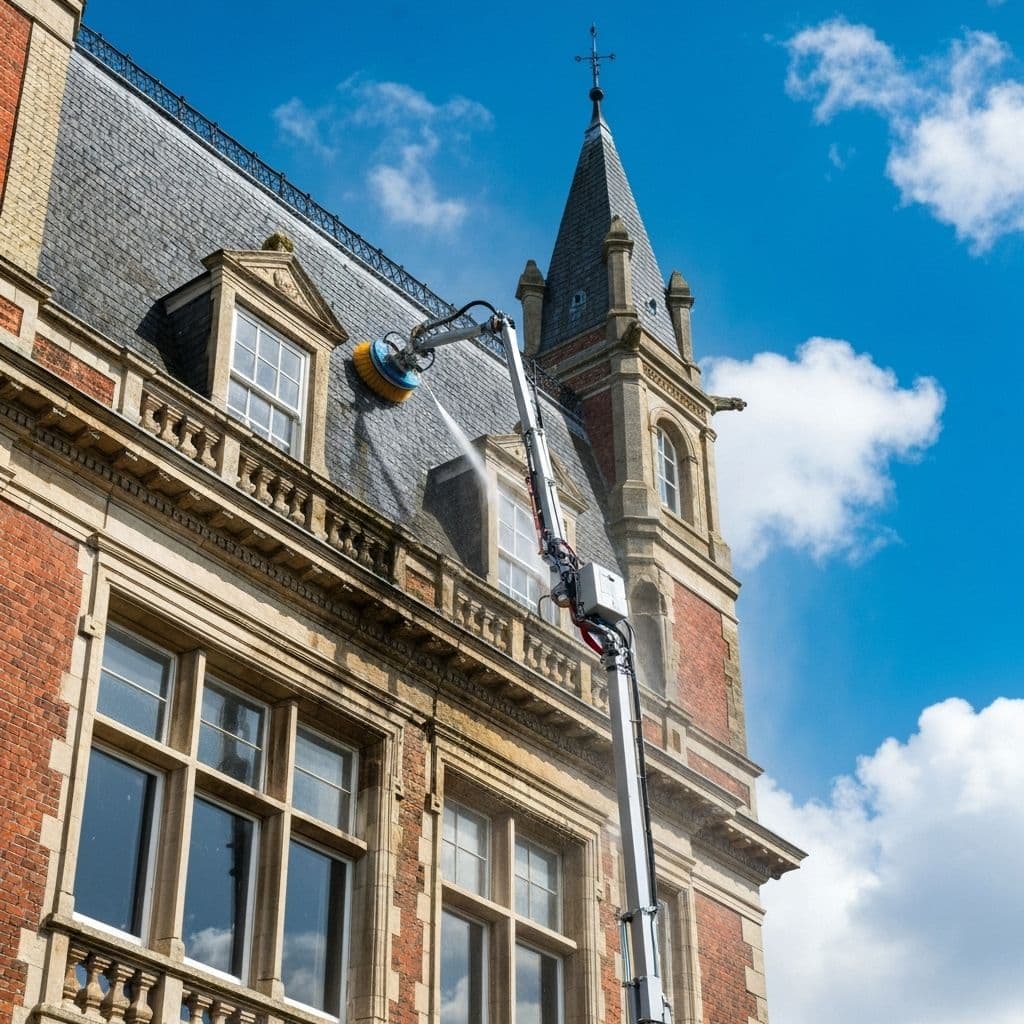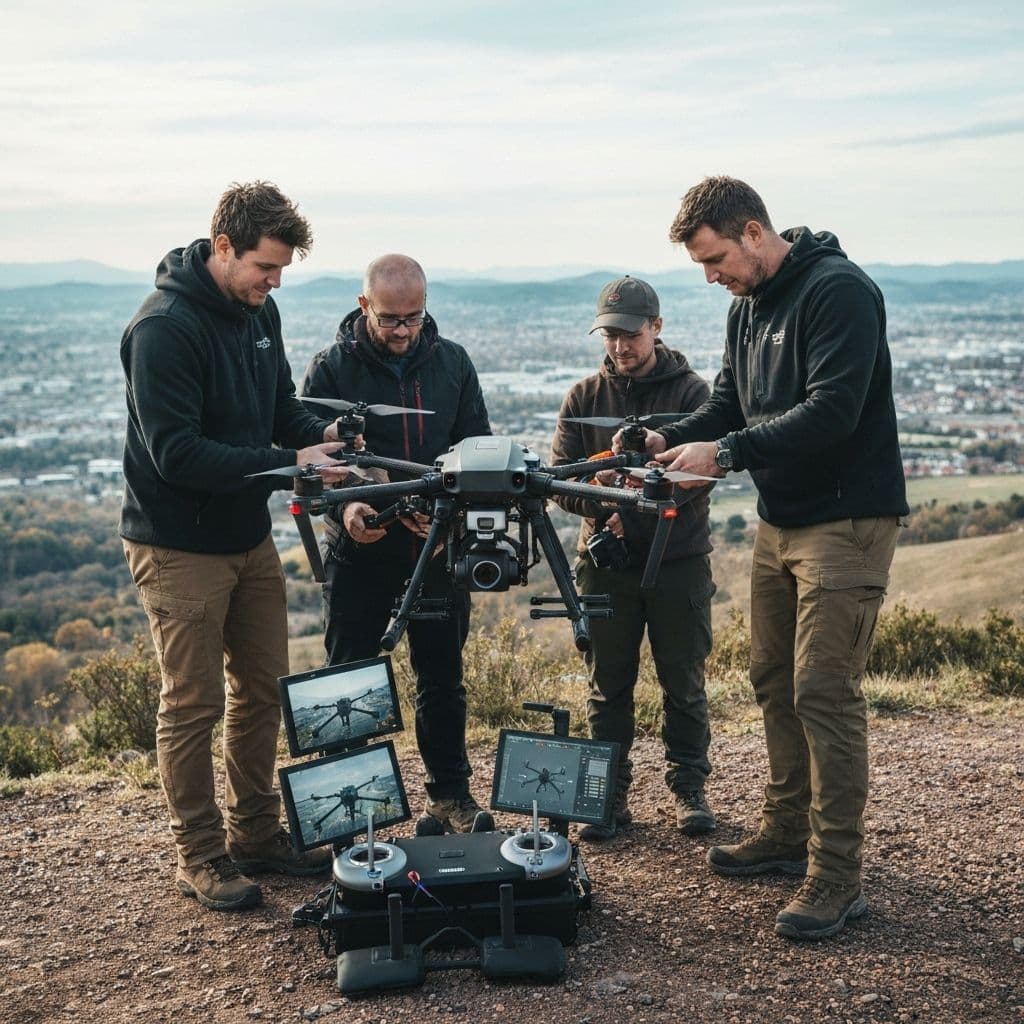
What the system actually is
Four components, and only one of them flies.
1. Flight platform. A DJI M350 RTK — 55 minutes endurance, 2.7 kg payload capacity, RTK positioning for centimetre-level station-keeping against a facade. The RTK part matters more than the endurance: cleaning quality depends on holding a consistent standoff distance from the wall, and consistent standoff is a positioning problem.
2. Ground-based high-pressure pump. Operating at 50–120 bar, adjusted to the cladding material. This stays on the ground.
3. Cleaning agent supply. Also on the ground, mixed and metered into the water line.
4. Safety tether. Physical retention, independent of the flight system.
The water and agent are supplied from the ground through a line to the drone's nozzle. The aircraft carries the nozzle and the line, not the fluid.
That architecture is the whole trick. Carrying water is what makes drone cleaning impractical — water is heavy and it depletes, so a tank-carrying aircraft has a short working cycle and a big payload penalty. Supplying from the ground means endurance is set by battery, and the agent mix can be changed mid-operation without landing.
The five-stage procedure
1. Site survey and flight planning. Building modelled, flight paths planned per elevation, exclusion zones and abort thresholds defined, airspace permit filed.
2. Equipment set-up and testing. Pump staged, line run, ground marshals positioned, pre-flight checklist signed off item by item — batteries, propellers, gimbal, spray system, signal link.
3. Zoned cleaning. The drone flies the planned path at set standoff, spraying and rinsing with defined overlap. Zoning matters for two reasons: it limits how much of the building is affected at once, and it lets pressure and agent be varied by elevation where materials change.
4. Quality inspection. Re-flight and comparison against the pre-work imagery, elevation by elevation.
5. Site reinstatement. Equipment struck, ground condition restored, operational video and comparison imagery delivered.
Throughput
Roughly 800–1,200 m² of facade per day.
For a mid-rise residential building of 3,000–4,000 m², that is three to five working days on site. Add the airspace permit lead time ahead of it — typically 14–21 working days.
Pressure by material
This is where the engineering meets the building fabric.
| Material | Approach |
|---|---|
| Glass curtain wall | Lower pressure, higher agent dwell — pressure risks seals, not glass |
| Glazed tile | Moderate pressure; the constraint is grout, not the tile face |
| Stone | Varies by porosity; textured stone needs dwell rather than force |
| Metal panel | Lower pressure, neutral agent — alkalinity and coatings interact |
The general rule across all four: dwell time beats pressure. Pressure is what damages grout, seals and finishes; agent contact time is what actually removes the soiling. Systems that lean on pressure produce a good photograph and a worse facade.
Coating integration
Because the ground supply can be switched, the same platform that cleans can apply a protective coating — after the substrate has dried.
The efficiency gain is real: one mobilisation, one permit, one set of exclusion zones, rather than two. But the sequence still has to be respected — clean, dry, then coat, with enough interval for the substrate to admit a penetrating sealer. Same-day coating defeats the purpose.
Where it is the wrong method
Being clear about this is the point of a technical piece.
Heavily oil-contaminated industrial facades. Where grease has bonded chemically over years, removal needs contact scrubbing. A non-contact method cannot deliver mechanical action, and no amount of agent substitutes for it.
Facades with extensive damage. If tiles are visibly loose or render is delaminating, cleaning should follow repair rather than precede it. Washing a facade with loose tiles risks dislodging them — which is both a safety issue and a way of turning a repair into an incident.
Sustained wind above 8 m/s. Our abort threshold. Above it, position-holding degrades and spray drift becomes unpredictable. On exposed coastal sites in certain seasons, the operating window may simply not open often enough to be practical, and saying so before contracting is better than discovering it during.
What it does better than anything else
Two things.
Nobody works at height. Not reduced fall risk — no fall risk, because there is no person up there.
Coverage is a plan, not a reach. An automated flight path with defined overlap covers above 99% of an elevation. Manual coverage is bounded by where an operative can get to, which varies with geometry, fatigue and time.
If you want to know whether your building suits the method — including whether it falls into one of the three exceptions — book an asset assessment or call +886-2-7733-7678.