Stage 1 — 3D survey and modelling
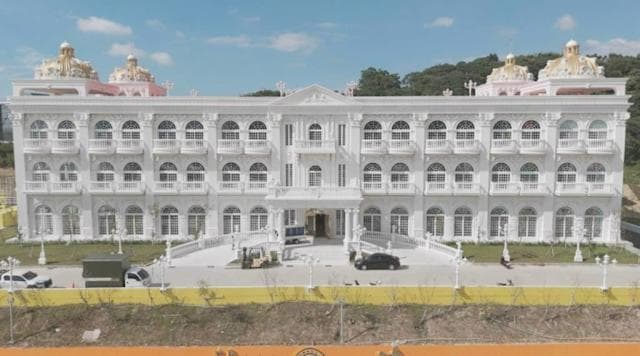
Before any cleaning is planned, we fly the building and build a digital twin — a dimensionally accurate 3D model of every elevation.
This is provided free of charge whether or not you proceed, and it does four jobs:
- Confirms detail invisible from the ground — parapet condition, sealant lines, the state of recessed areas
- Reads soiling distribution, so the cleaning plan targets where the dirt actually is rather than treating the building uniformly
- Measures facade area accurately, which is the basis of scope and price — and much more reliable than a perimeter estimate on an articulated building
- Generates the flight path the cleaning drone will fly
It also becomes the "before" image for the completion comparison at stage 5.
Stage 2 — Work plan
From the model we produce the plan: flight paths per elevation, cleaning agent selected for the cladding material, water pressure by material, working sequence, exclusion zones, ground marshal positions, and the abort thresholds for wind and rain.
This is also where the airspace permit application goes in. A standard case takes 14 to 21 working days to clear. We handle the application and the liaison with the Civil Aeronautics Administration — there is nothing for the building owner to file.
Plan around this. The permit, not the cleaning, sets your earliest start date.
Stage 3 — Deployment and safety preparation
On the day: ground exclusion zone set out, marshals positioned, water and agent staged, pre-flight checklist signed off item by item — batteries, propellers, gimbal, spray system, signal link.
Residents are notified in advance to close windows on the working elevations and clear balconies. Nobody is displaced and building access is unaffected.
Wind speed and weather are checked against the defined abort thresholds. If conditions are outside them, the day does not proceed. We do not lower the threshold to keep to a schedule.
Stage 4 — Automated flight-path cleaning
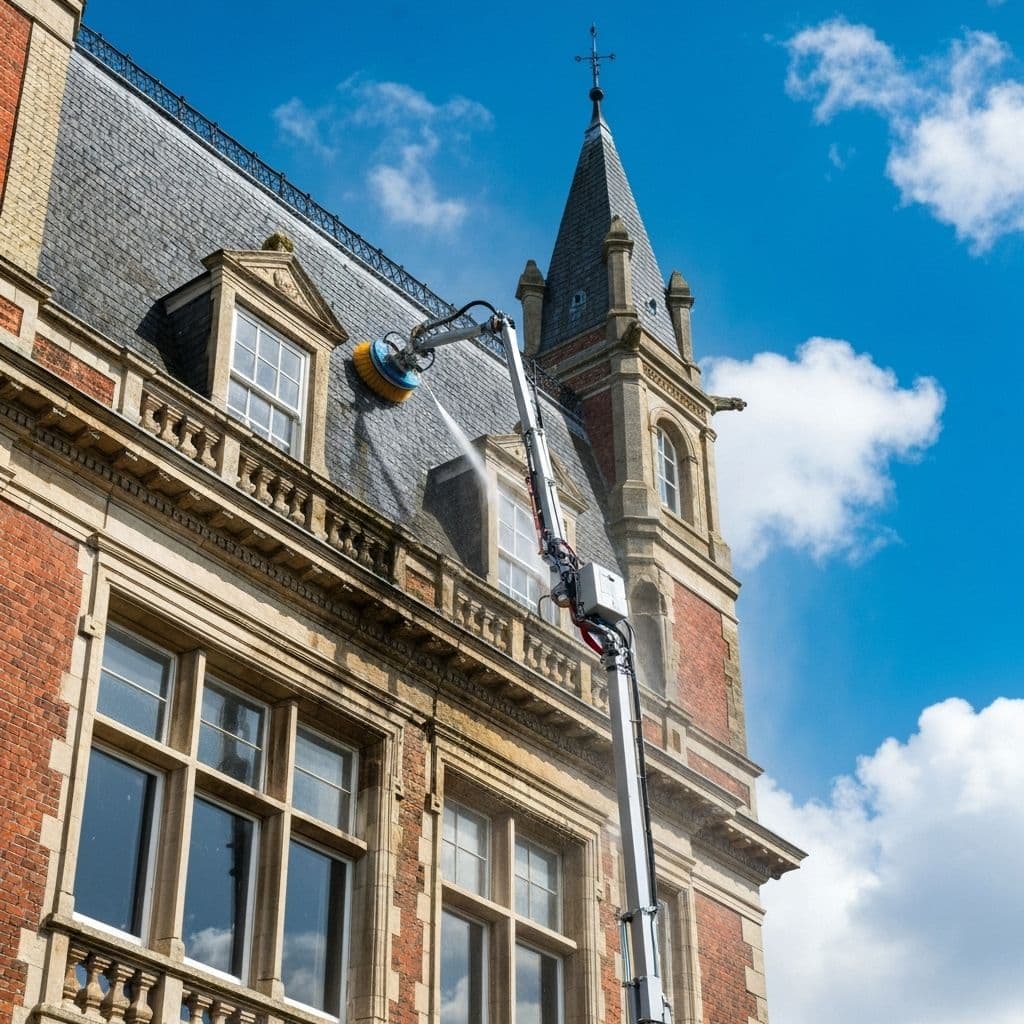
The drone flies the planned path, maintaining a set standoff from the facade while spraying and rinsing. Coverage is the point: an automated path with defined overlap achieves above 99% of the elevation, which is not attainable when the coverage depends on where an operative on a rope can reach.
An operator monitors throughout and can intervene at any point. High-resolution video is recorded for the whole operation and delivered with the job.
Cleaning agent is selected per material — neutral, biodegradable formulations that will not etch glass, corrode metal or attack stone. Run-off reaching planted areas does not damage them.
Stage 5 — Before-and-after comparison report
The building is re-flown and the result compared against the stage 1 model. You receive:
- Paired before-and-after imagery, elevation by elevation
- Full operational video record
- Note of any defects observed during the work — cracking, loose tiles, failed sealant — flagged for follow-up
That last item matters more than it sounds. A cleaning drone flies within a metre or two of the whole facade, so it sees things nobody has looked at in years. Cleaning is not a survey, but it does surface findings worth acting on.
How long a building takes
| Building | On-site duration |
|---|---|
| 10–20 storeys | 3–5 days |
| Above 20 storeys | 5–7 days |
Add the 14–21 working days for the airspace permit ahead of that, and for a residential building the committee resolution ahead of that.
Questions worth asking before the first job
- Is the airspace permit included, or are we filing it? It should be included.
- What cleaning agent, and is it appropriate for our cladding? Ask specifically about glass, metal and stone if you have them.
- What are the wind and rain abort thresholds? A provider who cannot state them does not have them.
- Is the operational video delivered? It is your record, not just theirs.
- What insurance is carried, and can we see the policy? Public liability and employer's liability, and the certificates should be available before signing.
One thing worth doing first
Cleaning restores appearance. It does not tell you what condition the facade is in — and on a building over about 20 years old, that is usually the more consequential question.
If you have not established a baseline, the sensible order is survey first, then clean what the survey says warrants cleaning. Diagnosis and treatment are separate for a reason: we do not recommend cleaning in order to sell cleaning.
Book an asset assessment or call +886-2-7733-7678.