How is a facade actually cleaned? Five methods compared, and how to choose
In brief: Five methods are in common use in Taiwan — manual brushing, boom lift with pressure washing, suspended cradle, rope access and drone cleaning. The choice should weigh building height, elevation geometry, safety, efficiency and budget together. Drone cleaning, with nobody working at height and a fast programme, is increasingly the first choice.
A building's facade is its face, and years of exposure to wind, rain, sun, air pollution and biological growth leave soiling, water marking and moss accumulating. That does more than look bad: it attacks the materials and degrades the waterproofing. So how is a facade actually cleaned, and what are the options?
What follows covers the five methods most commonly used in Taiwan, with the advantages, drawbacks, applications and safety considerations of each, to help you choose what suits your building.
1. Manual brushing (low level only)
How it works
The most basic method: a long-handled brush, a sponge or a domestic pressure washer, worked from the ground or reaching out through a window. It suits townhouses, low-rise buildings of one to three storeys, or anything reachable from a balcony.
Advantages
- The lowest cost, with no plant to hire
- Simple, and in some cases doable in-house
- Suits small-area localised cleaning and routine upkeep
Drawbacks
- Low level only; anything high is simply out of reach
- Limited coverage and low throughput
- Stubborn soiling — moss, rust staining — often will not shift
- Without professional equipment and agents, results are limited
Where it fits
Routine townhouse upkeep, shopfront cleaning, localised soiling at low level.
2. Boom lift with pressure washing
How it works
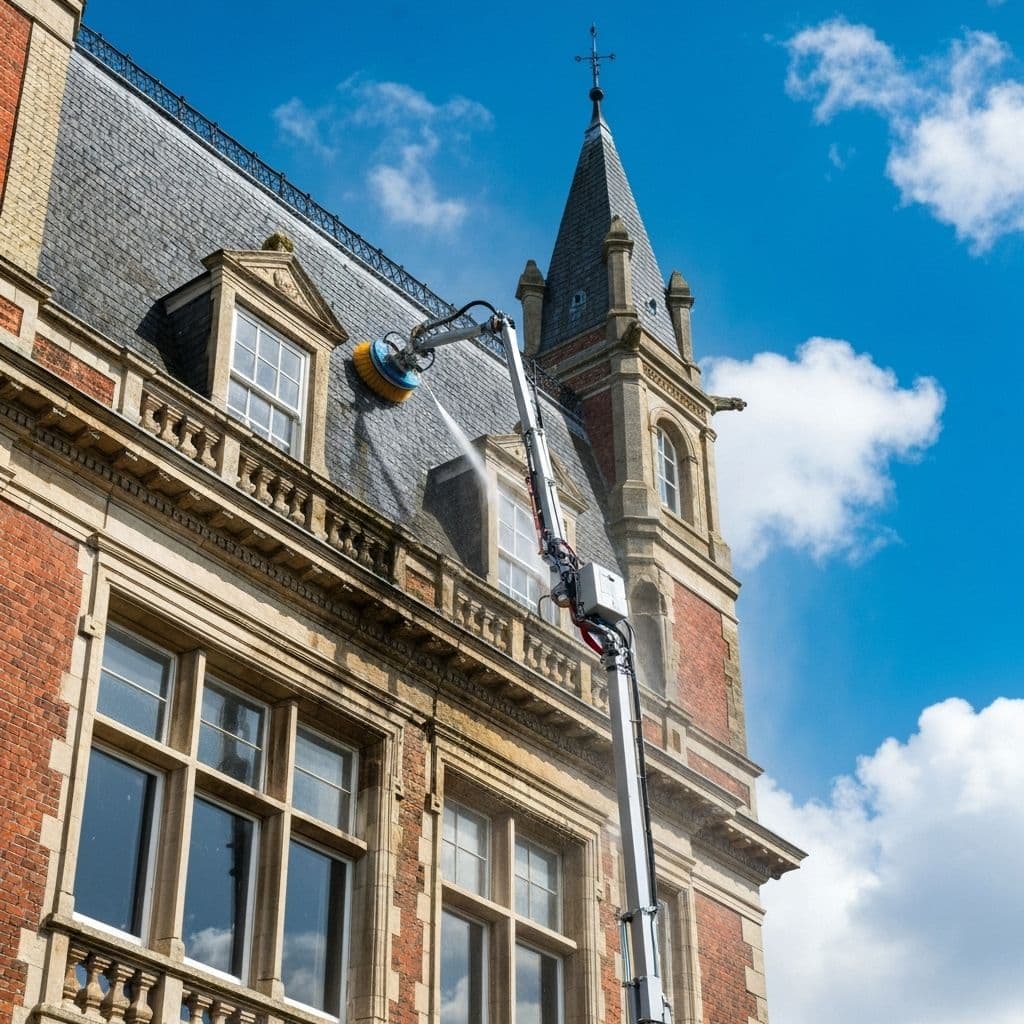
A mobile boom lift or cherry picker raises the operative and the pressure washing equipment to working height, and the facade is cleaned with a pressure jet and detergent.
Advantages
- A stable working platform, so the operative is comparatively safe
- Can carry more equipment and detergent
- Good throughput, and well suited to regular elevations
- A comparatively low unit rate — around NT$30–50 per ping
Drawbacks
- Needs adequate ground space for parking and working
- Lift hire is a fixed additional cost — around NT$15,000–40,000 a day
- May require a highway occupation licence and disrupt traffic
- Working height is limited by boom reach, usually under 50 metres
- Difficult to operate in dense urban settings with buildings close together
Where it fits
Low- and mid-rise buildings with open surroundings, industrial buildings, schools, standalone commercial buildings.
3. Suspended cradle (window-cleaning gantry)
How it works
A cradle system mounted on the building's roof lowers the operatives and equipment down the facade, cleaning level by level.
Advantages
- No height limit; suits even very tall buildings
- Occupies no ground space and does not affect surrounding traffic
- A comparatively stable platform that can carry substantial equipment
- Where a building already has a cradle system installed, cost falls sharply
Drawbacks
- Where no track is provided, temporary installation is expensive
- Movement is constrained by the track, so irregular elevations are hard to treat
- Work stops in strong wind, above around Beaufort force 5
- Equipment maintenance and safety inspection costs are high
Where it fits
Commercial towers, high-rise residential and hotels with cradle tracks already installed.
4. Rope access abseiling
How it works
Specialist rope access technicians descend from the roof on a rope system and clean the facade with a hand-held pressure lance and detergent.
Advantages
- The most manoeuvrable option; reaches almost any awkward position
- No large plant, and quick to mobilise
- Occupies no ground space
- Suits localised cleaning and small areas
Drawbacks
- Depends heavily on the individual technician's skill and experience
- The highest safety exposure of any method here
- Comparatively slow
- Labour-intensive, so the unit rate is high
- Work stops in strong wind and poor weather
- Extended periods suspended at height are physically demanding
Where it fits
Irregular elevations, cleaning after localised repairs, small areas in awkward positions.
5. Drone cleaning (the newest generation)
How it works
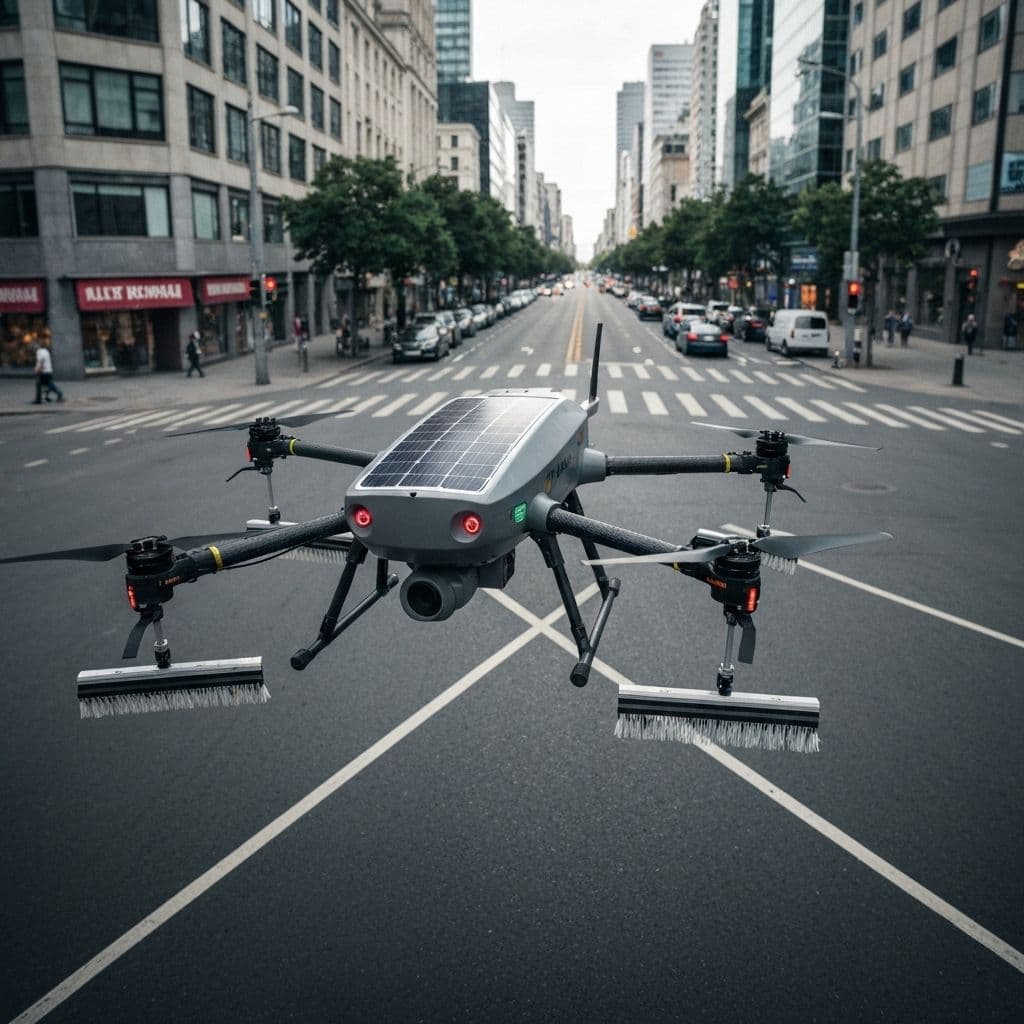
A trained operator flies a cleaning drone carrying high-pressure nozzles and detergent up to the facade and washes it. The detergent is fed either from an onboard system or from a ground supply, at a pressure sufficient to clean effectively. General Drone Service is a specialist provider of drone facade cleaning in Taiwan.
Advantages
- The safest option — nobody works at height, so the fall risk disappears
- Fast on site — materially quicker than traditional methods
- No space constraint — no ground parking, no cradle track
- No traffic impact — no road closure or highway occupation licence
- Reaches everywhere — including corners traditional methods struggle with
- Low impact — quiet, no heavy plant, minimal effect on residents and neighbours
Drawbacks
- Requires skilled operators holding the proper licences
- Payload is limited, so very large areas need repeated resupply runs
- Not suitable in strong wind or rain
- Comparatively few providers, so choosing an experienced one matters
Where it fits
Tall buildings, urban buildings with constrained surroundings, buildings traditional methods cannot easily treat, and properties that place a high value on site safety.
6. The five compared
| Manual | Boom lift | Cradle | Rope access | Drone | |
|---|---|---|---|---|---|
| Safety | High (low level) | Med-high | Med-high | Lower | Highest |
| Throughput | Low | Medium | Medium | Med-low | High |
| Height range | 1–3 storeys | Under approx. 15 storeys | Unlimited | Unlimited | Unlimited |
| Space needed | None | Substantial | Roof track | Roof anchors | None |
| Weather sensitivity | Low | Medium | Medium | High | Medium |
| Disruption to residents | Low | High | Medium | Low | Low |
7. Choosing the right method
Work through the following:
Step one: establish the building's conditions
- How tall is it? Above 15 storeys rules out a boom lift
- Is the elevation regular? Irregular geometry points to rope access or a drone
- Is there a cradle track on the roof? If so, the cradle is worth considering first
- Is there adequate ground space? If not, the boom lift is out
Step two: assess safety and regulatory requirements
Taiwan regulates work at height strictly, and crews need the relevant certification and equipment. When commissioning a contractor, confirm:
- Proper corporate registration and the relevant licences
- That the crew has been professionally trained
- That works accident and third-party liability insurance are in place
- That a complete method and safety statement is provided
Step three: compare on total cost, not unit rate
Do not look at the unit rate alone. Plant hire, permit applications, programme duration and safety exposure all belong in the comparison. A method that looks dearer per ping is often cheaper once the hidden costs are counted.
Step four: choose a capable contractor
Whichever method you settle on, the contractor's experience and reputation matter most. General Drone Service has extensive practical experience of facade cleaning and provides a site assessment, recommending the approach that fits your building's conditions.
Closing
Facade cleaning is not simply a matter of getting the building clean. The right method gives a better result, keeps the work safe, controls cost and limits disruption to occupiers. As drone technology has matured, more and more buildings are choosing it for exactly that combination of safety and efficiency.
If you are weighing up facade cleaning, get in touch — we will assess the building and advise on the approach that suits it.