Moss is telling you something
A facade with moss on it is a facade that stays wet. That is the actual finding; the green is just how you noticed.
Which means the useful response is not "how do we get rid of it" but "why is this elevation holding moisture, and what else is that doing to the building".
The four conditions
Biological growth establishes where these coincide:
1. Persistent moisture. Rainfall that does not drain, condensation, splash-back from a hard surface below, or water tracking down from a failed detail above.
2. Shade. North-facing elevations, light wells, the sides of buildings that neighbouring structures overshadow. UV is a natural suppressant; without it, growth persists.
3. A porous or absorbent surface. Tile grout lines, textured stone, painted render past its service life. Smooth, sealed surfaces are much harder to colonise.
4. A spore source. Mature planting close to the building, a neighbouring facade already colonised.
You usually cannot change 2 or 4. You can change 1 and 3 — which is where prevention lives.
Why it matters beyond appearance
Three mechanisms, in increasing order of consequence:
Sustained wetting. Moss holds water against the surface continuously rather than letting it dry between rainfall. That accelerates the wetting-drying cycling that breaks down grout and render.
Root intrusion. Rhizoids work into joints and hairline cracks. Every cycle widens them slightly, and a widened joint admits more water.
Debonding. On a tiled facade, sustained moisture reaching behind the tile is one of the drivers of adhesive failure. That is a hollowing problem, and hollowing is what precedes a tile coming down.
The appearance issue resolves itself in a day. The third one does not.
Removal methods
| Method | Suits | Watch for |
|---|---|---|
| Manual brushing | Small, reachable areas | Labour-intensive; impractical above two or three storeys |
| Chemical treatment | Established growth | Agent must match the material; run-off must be controlled |
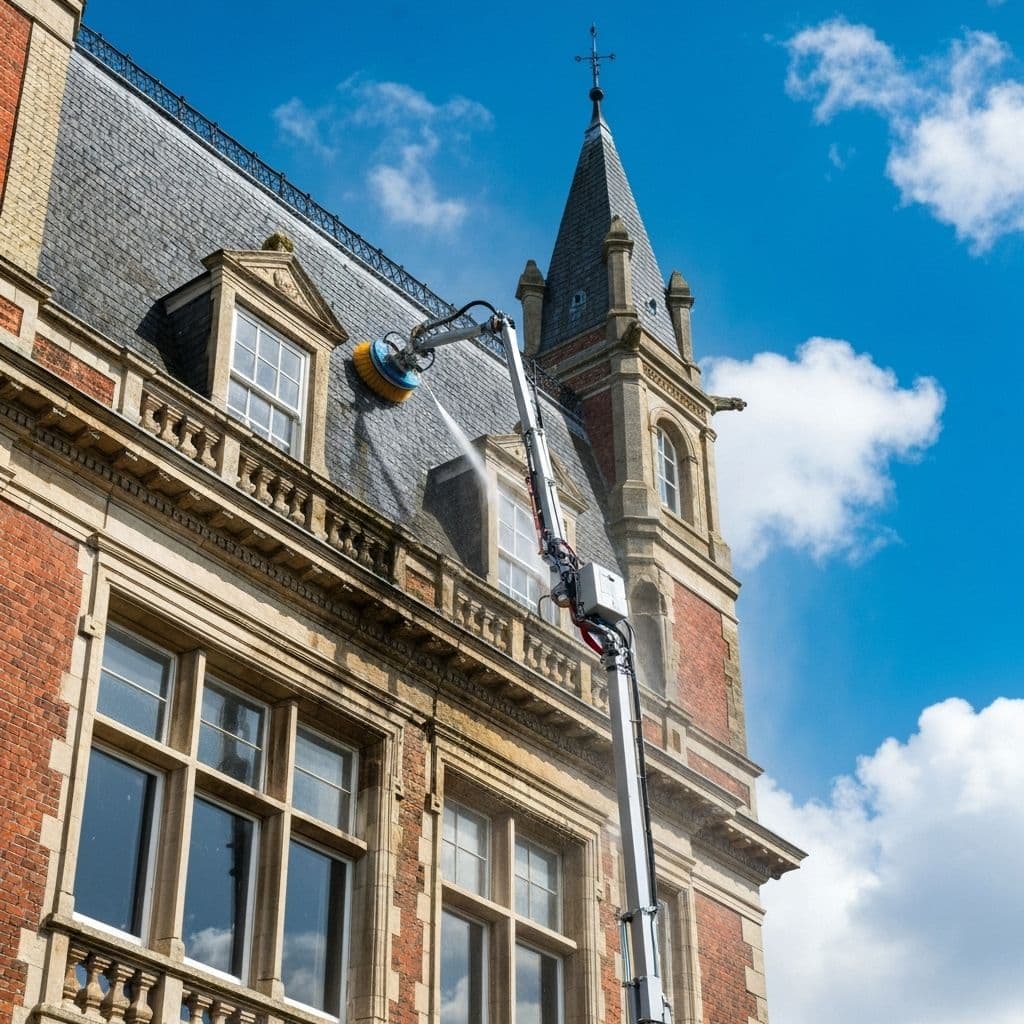
| Pressure washing | Most facades | Excessive pressure drives water into joints and erodes grout |
| Drone cleaning | High-rise, awkward geometry | Requires airspace permit lead time |
The recurring error is too much pressure. Moss removal is not a force problem — it is an agent-and-dwell-time problem. High pressure appears effective because the green disappears quickly, while driving water behind tiles, eroding grout and stripping render. It makes the underlying condition worse while improving the photograph.
Our approach is a neutral, biodegradable agent at a pressure matched to the cladding, adjusted per material across the elevation. Run-off reaching planted areas does not damage them — which matters, because the planting is often part of why the elevation is shaded and damp in the first place.
Prevention: the part that determines whether it returns
Removal alone buys you a season or two. Four measures change the trajectory:
Anti-microbial or hydrophobic coating. A protective coating makes the surface shed water instead of holding it, which removes condition 1 at the surface. Silane and siloxane penetrants also close the pore structure that condition 3 depends on.
Repair the waterproofing. If growth clusters below a particular detail — a coping, a window head, a joint — the water is coming from there. Sealing that costs a fraction of repeatedly cleaning what it causes.
Improve drainage. Blocked outlets, ponding on ledges, a downpipe discharging onto the wall. Cheap to fix, disproportionately effective.
Clean on a cycle. Every one to two years. Regular cleaning prevents establishment; irregular cleaning removes what has already established, which is harder and more aggressive.
The right sequence
- Survey — find where the water is coming from, and check whether the sustained moisture has already caused debonding behind the tiles
- Repair the source
- Clean
- Coat, so the surface stops holding water
- Re-clean on cycle
Skipping straight to step 3 is what makes moss a recurring line item rather than a resolved one.
If your facade has moss on a particular elevation, the question worth answering first is what else that moisture has been doing. Book an asset assessment or call +886-2-7733-7678.