Six kinds of stain, six treatments
Tiled facades do not have one cleaning problem. They have six, and treating them all the same is how facades get damaged by their own maintenance.
1. Water staining and mineral deposits
Streaks below sills, copings and joints where water runs consistently. Mineral content in the water deposits as it evaporates.
Treatment: mildly alkaline agent with dwell time, low pressure. Not acid — acid works quickly on mineral deposits and etches the glaze while doing it.
2. Rust and metal oxide staining
Orange-brown bleed, usually below a fixing, a railing or a metal component.
Treatment: a specific oxide remover, applied locally. Worth noting: the stain is a symptom of something corroding. Cleaning it without addressing the source means it returns, and the source is usually more consequential than the mark.
3. Moss and algae
Green or black growth on shaded, damp elevations.
Treatment: biocidal agent with dwell time, then rinse. As with rust, the growth is a symptom — see removing moss from a facade for why removal without addressing moisture just resets a clock.
4. Efflorescence
White crystalline deposit, often around joints and at the base of elevations.
Treatment: the deposit itself brushes and rinses off readily. But efflorescence is a diagnostic finding, not a cleaning problem: it means water is moving through the substrate, dissolving soluble salts and evaporating at the surface. Clean it and leave the water path, and it returns within months.
5. Cooking and traffic pollution films
Greasy deposits — near extract outlets, on elevations facing heavy traffic.
Treatment: degreasing agent with dwell time. These respond poorly to pressure alone, because the bond is chemical rather than mechanical.
6. Graffiti and paint
Treatment: solvent selected for the paint type and the tile finish. This is the one case where trial on an inconspicuous area first is essential, because the wrong solvent can lift the glaze along with the paint.
The agent question
The recurring damage mechanism on tiled facades is strong acid.
It persists in the market because it works, visibly and fast, on mineral deposits and efflorescence. What it also does is etch glaze, attack grout, and corrode any metal it reaches — including fixings behind the facade that nobody can see.
None of that shows on the day. It shows in three years, as a facade that soils faster than it used to because the glaze is no longer smooth.
Our formulations are mildly alkaline and non-corrosive, suited across tile materials, and biodegradable enough that run-off reaching planted areas does not damage them.
The pressure question
The other recurring damage mechanism is too much pressure.
Glazed tile faces tolerate pressure well. Grout does not. Grout is porous, softer, and erodes under pressure the tile shrugs off — and eroded grout is precisely the path water needs to get behind the tile, which is one of the drivers of debonding.
So the counterintuitive rule on tiled facades: cleaning that looks most effective in the moment is often the one causing the damage. Correct practice is lower pressure with the right agent and adequate dwell time, adjusted per material across the elevation.
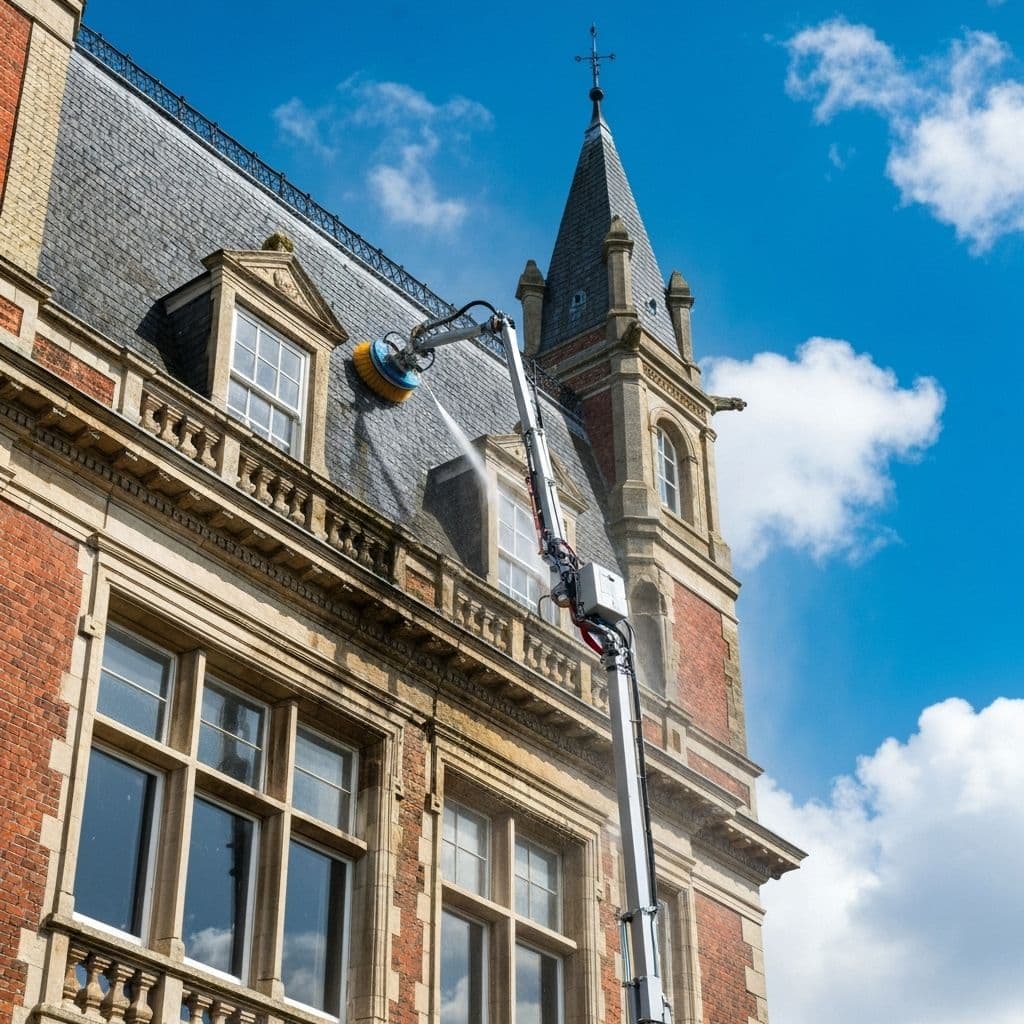
Drone application helps here because pressure and standoff distance are controlled precisely and consistently, rather than varying with how an operative is positioned.
How often
| Building type | Interval |
|---|---|
| Residential | Every 1–2 years |
| Commercial | Every 6–12 months |
| Industrial area / heavy traffic route | Quarterly |
The economics favour the shorter interval more than people expect. Established soiling costs 30–50% more to remove than soiling that has not, and it takes more aggressive treatment — which is where facade damage comes from. Regular gentle cleaning is cheaper and safer for the fabric than occasional aggressive cleaning.
After cleaning
A tiled facade that has just been cleaned is the best moment to apply a protective coating. The surface is clean, so the penetrant bonds properly, and once coated the tile sheds water rather than absorbing it — which slows every mechanism described above.
The sequence is clean, dry, then coat, never coat first.
If the tiles are older
On a tiled facade past about twenty years, cleaning is the second question. The first is whether tiles are debonding behind the surface — invisible from the ground, and the precursor to one coming down.
Book an asset assessment or call +886-2-7733-7678.