The complete guide to solar panel cleaning: efficiency, cost and return
In brief: Soiled panels lose 10–25% of their generation, and cleaning every three to six months protects the output. Drone cleaning runs around NT$9–11 per panel against NT$12–14 for manual work — cheaper and safer. Below: intervals, a cost comparison and a worked return calculation.
As Taiwan pushes renewable energy, solar generation is spreading steadily. Rooftop residential, ground-mounted plant, industrial roof arrays — all of it is a substantial investment. But many owners overlook one factor that bears directly on output: keeping the panels clean.
Under Taiwan's climate, an uncleaned array can lose 10–25% of its generation. That means a solar investment quietly shedding tens of thousands of dollars in generation revenue every year. What follows covers why cleaning matters, how often, how the methods compare, and what the return looks like.
1. Why cleaning matters
What soiling costs directly
A solar panel works by converting sunlight through the photovoltaic effect. Dust, bird droppings, leaf litter, pollen or industrial deposits on the surface block sunlight from reaching the cells, cutting output directly.
Measured effects by type of soiling:
- General dust accumulation: 5–10% loss
- Localised bird droppings: 15–20% loss, with hot spots a real risk
- Industrial oily deposits: 15–25% loss
- Leaf litter and pollen: 10–15% loss
- Coastal salt spray: 10–20% loss
The hot spot risk
Where part of a panel is shaded by droppings or leaves, the shaded cell cannot generate but becomes a resistance in the circuit, and its local temperature rises sharply — the hot spot effect. Left untreated, a hot spot can permanently damage the cell, and in severe cases presents a fire risk.
The return on maintenance
A solar system typically has a service life of 20–25 years. Regular cleaning maintains output and extends equipment life, protecting the long-run return. On a 10kW residential system, annual generation losses to soiling run around NT$8,000–15,000, against a cleaning cost of only NT$3,000–5,000 — a comfortable margin.
2. Optimal cleaning intervals
Set by the environment
There is no single answer; the interval follows where the array is installed:
- Ordinary residential areas: every 4–6 months
- Industrial areas or busy traffic corridors: every 2–3 months
- Coastal locations: every 2–4 months, given the salt spray risk
- Agricultural or heavily wooded settings: every 3–4 months, for pollen and leaf litter
- Large ground-mounted plant: a full clean every 3–6 months
Seasonal considerations
Taiwan's climate also shapes the schedule:
- Spring (March–April): pollen season — worth a clean
- After the plum rains (June–July): mineral deposits from rainfall — worth a clean
- Autumn (October–November): leaf fall — increase inspection and cleaning
- Dry winter: dust accumulates faster; schedule as conditions require
3. Manual versus drone cleaning
Manual cleaning
Cleaning crews go up onto the roof, or use access equipment, and wash the panels by hand with water and a soft brush.
Advantages:
- A low technical barrier, so contractors are easy to find
- Localised stubborn staining can be worked on directly
Drawbacks:
- Crews must go onto the roof, with the fall risk that carries
- Walking on panels can cause micro-cracking
- Slower, so large arrays take a long time
- Higher water use, which matters where supply is constrained
Drone cleaning
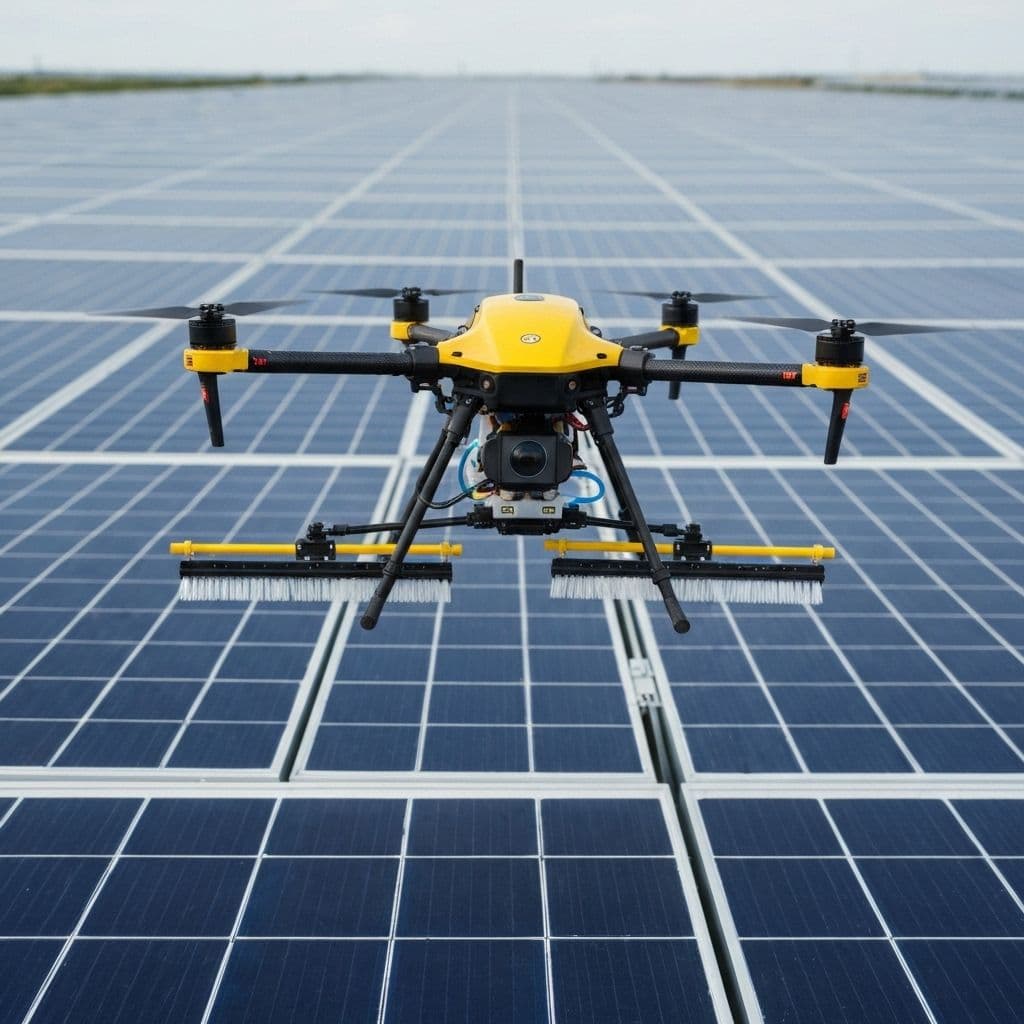
We use professional aircraft including the DJI M350 RTK carrying a cleaning module, flown under remote control.
Advantages:
- No fall risk — flown remotely, with nobody working at height
- No contact with the panel — so no micro-cracking from being walked on
- Materially faster on large arrays — roughly 200 panels a day by hand against 800–1,000 by drone
- Precise positioning — RTK positioning ensures nothing is missed
- Survey at the same time — thermal imaging can run in parallel, catching hidden faults
Drawbacks:
- Requires a skilled flight team
- Cannot operate in extreme weather — strong wind or heavy rain
Cost compared
| Manual | Drone | |
|---|---|---|
| Cost per panel | NT$12–14 | NT$9–11 |
| Throughput | approx. 200 panels/day | approx. 800–1,000 panels/day |
| Safety exposure | Med-high (work at height) | Very low (remote) |
| Risk of panel damage | Medium (from walking on panels) | Very low (non-contact) |
| Water efficiency | Average | Better (precise spray) |
4. Worked return calculation
Taking a 100kW ground-mounted array:
Baseline
- System capacity: 100kW
- Annual generation, clean: approximately 120,000 kWh
- Feed-in tariff: approximately NT$4.5/kWh
- Expected annual revenue: approximately NT$540,000
The cost of not cleaning
- Assume soiling costs 15% of output
- Annual generation lost: 120,000 × 15% = 18,000 kWh
- Annual revenue lost: 18,000 × 4.5 = NT$81,000
The cost of cleaning three times a year, by drone
- Panels: approximately 300
- Cost per clean: 300 × 10 = NT$3,000
- Annual cleaning cost: 3,000 × 3 = NT$9,000
The return
- Net gain: 81,000 − 9,000 = NT$72,000 a year
- Return: 72,000 ÷ 9,000 = 800%
Which is to say that every dollar spent on cleaning returns roughly eight dollars in additional generation revenue.
5. Safety points
Whichever method is used, the following apply:
- Do not clean in the heat of the day — panel surface temperatures reach 60–70°C at midday, and cold water can cause thermal shock cracking. Clean early morning or evening
- Use pure water or an approved agent — never anything abrasive, which will scratch the glass
- Do not use a high-pressure lance — excessive pressure damages the panel's sealing gaskets
- Confirm the electrical position — check whether the system needs isolating before cleaning
- Work-at-height safety — where cleaning manually, harnesses and fall protection are mandatory
6. Choosing a cleaning contractor
Points worth weighing:
- Proper equipment — professional aircraft such as the DJI M350 RTK with a purpose-built cleaning module
- Survey capability — thermal imaging alongside the clean, catching failing cells early
- Insurance and safety certification — confirm the contractor's works insurance is adequate
- Track record — previous solar sites they have worked on
- Transparent pricing — whether the quotation covers cleaning agents, water and travel
Closing: cleaning is what makes a solar investment pay
Solar panel cleaning looks like simple maintenance, but it bears directly on output and on long-run return. Wherever your system is, it is worth writing regular cleaning into the annual maintenance plan so that every hour of sunlight converts into actual revenue.
General Drone Service provides professional drone solar panel cleaning, combining DJI M350 RTK precision positioning with an efficient cleaning module — a safe, fast and economical option for your array.
Want to know more?
- See our drone cleaning services for the process and technical specification
- Review how cost is assessed
- Get in touch to arrange a site assessment