How often should solar panels be cleaned? A frequency table for six site environments
Cleaning frequency is not a case of more being better — it follows the site environment. Coastal salt-spray sites every 3 months, industrial zones every 4, ordinary urban sites every 6, clean rural sites every 12. Over-cleaning simply adds cost; leaving panels uncleaned lets yield decline steadily. Below: recommended intervals for six typical environments, the yield recovery you can expect, and how to calculate the return.
Frequency by environment
| Environment | Recommended interval | Main soiling source |
|---|---|---|
| Coastal salt-spray zone (within 3km of the sea) | 3 months | Salt spray, airborne sea deposits |
| Industrial zone / motorway margin | 4 months | PM2.5, oily exhaust, airborne dust |
| Heavy bird activity / tree shade | 4 months | Droppings (hot spots), leaf fall |
| Ordinary residential and urban | 6 months | Urban dust, light PM2.5 |
| Clean rural (low pollution) | 12 months | Ordinary settled dust |
| Aquavoltaic / floating | 2–3 months | Moisture, droppings, algae |
A rooftop array pitched at 20° or steeper gets good natural rain washing and can extend by 1–2 months. A near-flat array under 10° collects dust and water marks and should follow the table.
Full detail on environmental factors: the complete guide to solar panel cleaning.
What soiling costs in generation
| Type of soiling | Generation loss | Note |
|---|---|---|
| Even thin dust | 5–10% | Across-the-board reduction |
| Heavy dust layer | 15–25% | Moderate pollution |
| Localised bird droppings | 30–60% | Hot spot — loss exceeds the area covered |
| Moss / lichen | 40%+ | Adheres firmly; needs a specialist agent |
| Large-scale leaf fall / tree shade | 50%+ | Some modules fully shaded |
The key concept here is the hot spot caused by bird droppings. Once droppings shade a single cell, that module enters reverse bias and the shaded area becomes a resistive heat source. The loss is far greater than the 1/72 of the module the droppings actually cover — and over time it can permanently damage the module.
Yield recovery after cleaning
Depending on how heavily soiled the array was, cleaning typically recovers:
- Light dust conditions: 5–10%
- Moderate soiling: 15–20%
- Heavy soiling (moss or thick droppings): 20–25%
We provide a before-and-after generation comparison report — the seven-day average before cleaning against the seven-day average after — so the owner can see the effect for themselves.
Worked ROI example
Taking a 100kW rooftop array:
| Item | Figure |
|---|---|
| Installed capacity | 100 kW |
| Annual generation (Taiwan average) | approx. 120,000 kWh |
| Feed-in tariff | approx. NT$5/kWh (per contract) |
| Annual revenue | NT$600,000 |
| Loss at 10% soiling | NT$60,000 |
| Two cleans a year | NT$30,000–40,000 |
| Net recovery | NT$20,000–30,000 / year |
| ROI | 150–200% |
Conclusion: 50kW and above shows a clear return. Residential systems under 10kW can extend to one clean a year.
Why non-contact drone cleaning
The main hidden risk in manual cleaning is the micro-cracking caused by walking on panels:
- The cracking is invisible at the time of cleaning
- It widens progressively under thermal cycling into visible cracks
- Five to ten years later it shows up as unexplained generation decline
- By which point the module warranty has usually expired and there is no claim
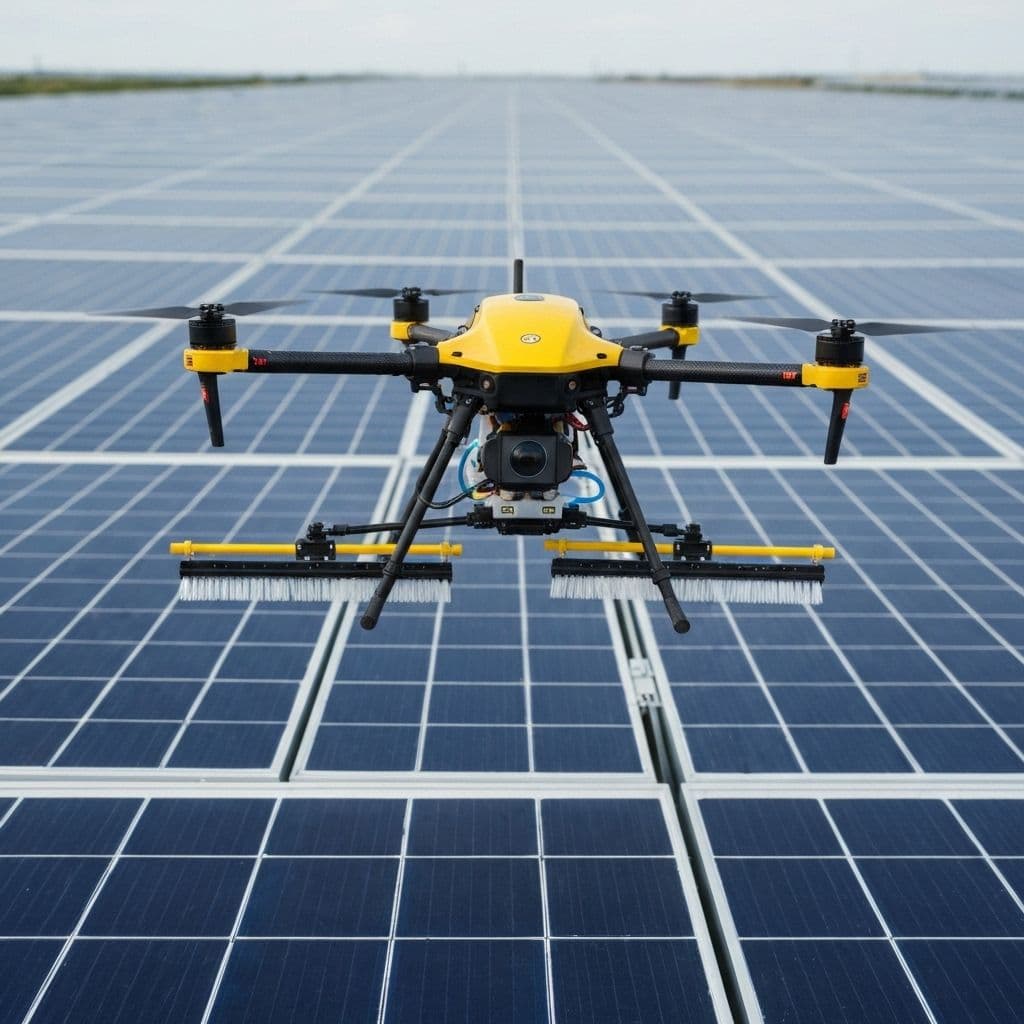
Drone cleaning:
- No contact with the panel at any point
- Pure water or a neutral, biodegradable agent
- Spray pressure set to 10–30 bar — enough to lift soiling without harming the anti-reflective coating
- A mid-size site under 200kW completes within half a day
What to do next
- Identify which environment your site falls into, and take the interval from the table
- Check whether generation over the last 12 months is more than 8% below expectation
- Arrange a site assessment (aerial survey and a thermal quick-check can be done at the same time)
- Put an annual O&M agreement in place, which insurers will often price against
📞 +886-2-7733-7678 (Mon–Fri 09:00–18:00) 🌐 Drone cleaning and inspection solutions 📖 The complete guide to solar panel cleaning: technology, cost and ROI in full