The penalty, precisely
Failing to carry out and file a building public safety declaration is penalised under Article 91(1)(4) of the Building Act: a fine of NT$60,000 to NT$300,000.
Three features of that provision matter more than the headline number.
The range is discretionary. Where the authority lands within it depends on building type, how long non-compliance has run, and whether there is a history.
It can be continuing. Article 91 permits repeated penalties where a building remains non-compliant after the remedy period. It is not a one-off cost you can price in and move on from.
It is not the most serious sanction available. The same article allows suspension of use, suspension of water and electricity supply, or closure. These are rarely reached, but they exist, and their existence is why "we'll just take the fine" is not a strategy a management committee should minute.
Why 2026 matters specifically
Taipei's Department of Urban Development has published a list of 913 commercial-district buildings required to complete their first facade safety diagnosis filing by 31 December 2026.
First filings concentrate risk in a way subsequent ones do not. A building that has filed before has a provider relationship, a baseline report and a committee that understands the process. A building filing for the first time has none of those, and is doing all of it inside one deadline.
The three-step recovery
If you are non-compliant or close to it, the path back is short and the sequence is fixed.
Step 1 — Confirm your status
Check the Taipei Building Administration's published register and any official correspondence you have received. You need to know two things: whether the building is listed, and which filing round it is in.
This step costs nothing and takes a day. Skipping it is how committees discover in November that they were listed in March.
Step 2 — Engage qualified personnel and produce a signed report
The filing requires a report signed by a qualified inspector recognised by the Department of Urban Development, and where significant defects are found, a diagnostic remediation report signed by a licensed architect or a practising civil or structural engineer.
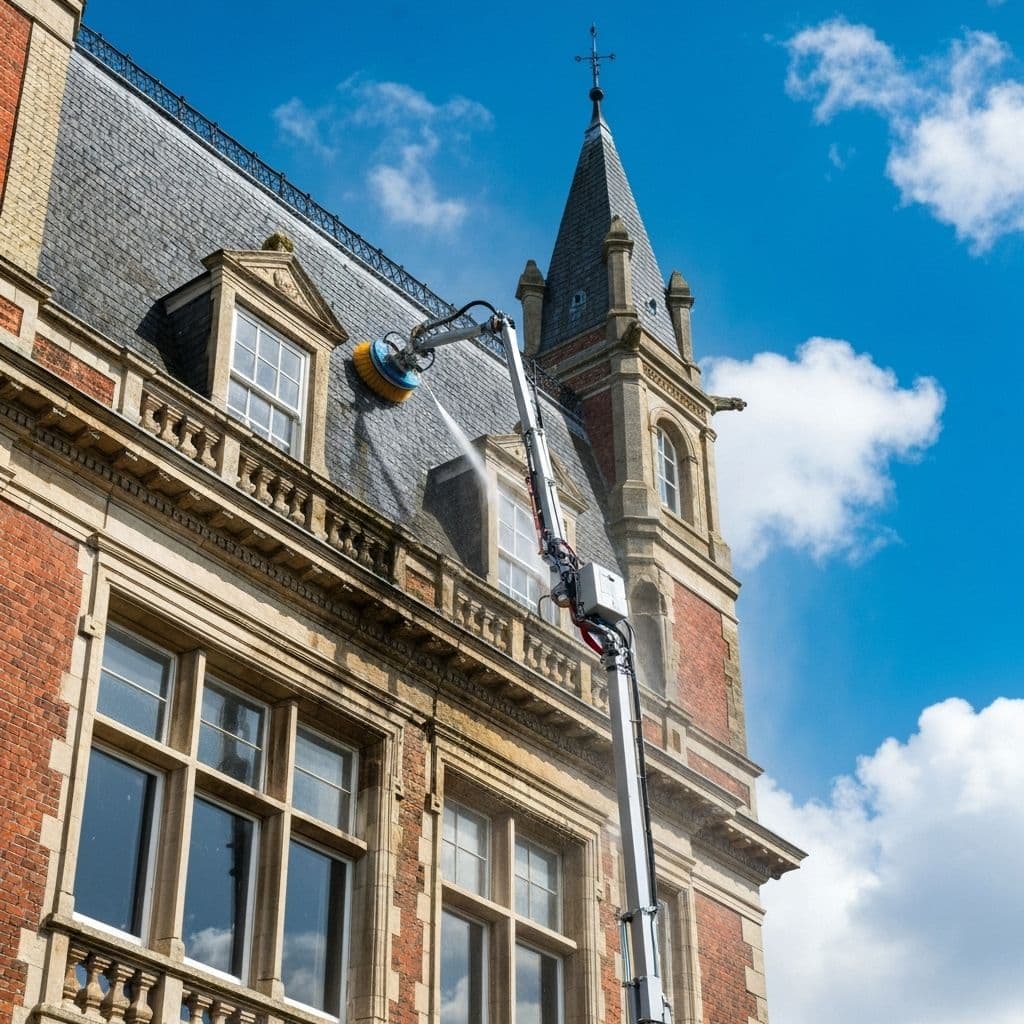
The survey itself is quick. A drone facade survey completes the site work in roughly half a day for a typical building — no scaffolding to erect, no road-occupancy permit, no closed circulation routes. Analysis and defect scheduling follow, then the professional attends to verify and sign.
From engagement to submission, the fastest realistic path is around 14 working days.
Step 3 — File through the system
Submit the completed, signed report through the Building Administration's filing system, and retain a copy for the committee's records. Providers commonly handle submission as an add-on; either way, minute that it was done.
What it costs to comply
For context against the NT$60,000–300,000 penalty:
- Three-year annual health contract: NT$35/m² × facade area, covering three surveys
- Single survey, no contract: NT$25/m² × facade area
A mid-sized community with 3,000 m² of facade comes to roughly NT$105,000 for the three-year contract — about NT$35,000 a year, spreadable across the public fund over three years.
Set against a penalty that can recur, and against the fact that the filing still has to happen afterwards, the arithmetic is not close.
The part committees underestimate
The obligation does not end with this round. Under Taipei's regulations, a building filing its first facade safety declaration will file again at 50 years, and every 10 years after that.
A committee that treats each round as a standalone emergency will run this fire drill repeatedly. A committee that puts facade survey into the annual maintenance budget — as a recurring line item rather than a special resolution — never has to. The intervening years are also where the useful information lives: annual survey on the same flight path produces a deterioration rate, and a rate is what a maintenance budget is built from.
That is the difference between compliance and asset health management.
If your deadline is close
Start with the register check, then the committee resolution — those are the two steps you cannot compress or delegate.
For the survey side, including report formatting for sign-off: book an asset assessment or call +886-2-7733-7678. The full process is set out in the statutory filing process, end to end.