Work at height on a facade: the regulations, and how a management committee avoids joint liability
In brief: Facade work at height carries complex regulatory and insurance obligations, and a management committee can find itself jointly and severally liable for sums running into millions. What protects against it: selecting a qualified contractor with the right credentials, licences and insurance; signing a formal contract; and supervising the work. In one reported case a committee that had not confirmed its contractor's capability to work safely was held jointly liable for NT$8 million.
For a committee chair, a property manager or a plant manager, the worry about facade work at height is not the cost. It is joint and several liability.
Taiwan sees serious work-at-height accidents every year. When one occurs, liability does not stop at the contractor: the management committee or company that commissioned the work may be jointly liable, for sums that run into millions.
Understanding the regulations, selecting a qualified contractor and planning the insurance properly is what protects against that.
What follows covers:
- The regulations governing facade work at height
- A management committee's legal duties
- What has to be established for joint liability to arise
- How to select a qualified contractor
- Insurance planning and risk management
- Reported cases and how they were decided
⚖️ 1. The regulations
Facade work at height is governed by the Occupational Safety and Health Act, the Construction Safety and Health Facility Standards and the Building Act. Breach can bring administrative fines, criminal liability and civil damages.
The Occupational Safety and Health Act
What it requires
An employer — including a contractor engaged by a management committee — must:
- ✅ Provide a safe working environment meeting the applicable standards
- ✅ Provide protective equipment as required
- ✅ Deliver safety training to the workforce
- ✅ Establish safe systems of work and apply them
- ✅ Arrange health surveillance for the workforce
Consequences of breach
- 💰 Fines of up to NT$300,000
- 💰 Criminal liability where injury or death results
- 💰 Civil damages
The Construction Safety and Health Facility Standards
What they require for work at height
- ✅ Protective measures — guardrails, safety nets and similar
- ✅ Harnesses worn by the workforce
- ✅ Pre-work equipment inspection
- ✅ Access control keeping unauthorised persons out of the working area
Consequences of breach
- 💰 Fines of up to NT$150,000
- 💰 Suspension of work in serious cases
- 💰 Civil damages
The Building Act
What it requires for facade maintenance
- ✅ Compliance with building regulation
- ✅ No effect on structural safety
- ✅ No effect on public safety
- ✅ Permits obtained where required
Consequences of breach
- 💰 Fines of up to NT$300,000
- 💰 Demolition orders in serious cases
- 💰 Civil damages
🏛️ 2. A management committee's legal duties
Under the Condominium Administration Act, a management committee is:
- ✅ The managing body responsible for the building's management and maintenance
- ✅ The representative of all co-owners in carrying out management functions
- ✅ Under a duty of care for the building's management and maintenance
What the committee must do
1. Maintain the building's safety
- ✅ Inspect regularly
- ✅ Maintain promptly where work is needed
- ✅ Ensure the work meets safety standards
2. Select a qualified contractor
- ✅ Review the contractor's credentials and licences
- ✅ Confirm the insurance position
- ✅ Sign a formal contract allocating responsibility
3. Supervise the work
- ✅ Monitor whether the contractor is working to the safety standard
- ✅ Require the necessary safety measures
- ✅ Record the work as evidence
The scope of the committee's exposure
Direct liability
Where the committee itself breaches its legal duties:
- 💰 Administrative — fines
- 💰 Civil — damages
- 💰 Criminal — in serious cases
Joint liability
Even without a direct breach, if the committee:
- ❌ Selected an unqualified contractor — one lacking the credentials or licences
- ❌ Did not confirm the insurance position
- ❌ Did not supervise the work against the safety standard
it may still be jointly and severally liable.
💼 3. What establishes joint liability
What joint and several liability means
- ✅ More than one liable party for the same loss
- ✅ A joint relationship between them
- ✅ Full liability on each — any one of them can be pursued for the whole sum
What has to be established
1. Loss
- ✅ Injury or death to a worker or a third party
- ✅ Property damage
- ✅ Causation between the loss and the work
2. Wrongdoing
- ✅ Breach of regulation — the Occupational Safety and Health Act, the facility standards
- ✅ Negligence — safety measures not applied, equipment not provided
- ✅ Intentional conduct — proceeding in known dangerous conditions
3. The liable parties
- ✅ The contractor — directly liable
- ✅ The management committee — potentially jointly liable
- ✅ Others involved, such as the property management company
Reported cases
Case one: contractor and committee jointly liable
Facts:
- A management committee engaged a contractor for facade cleaning
- The contractor did not apply the required safety measures, and a worker fell and died
- The family claimed against both the contractor and the committee
Decision:
- The contractor was directly liable
- The committee, having failed to confirm the contractor's capability to work safely, was jointly liable
- Damages: NT$8 million
Case two: committee not liable
Facts:
- A management committee engaged a contractor for facade cleaning
- The committee had confirmed the contractor's credentials and licences
- The committee had confirmed the insurance position
- The committee had supervised the work and required safety measures
- A worker fell and died through personal negligence
Decision:
- The contractor was directly liable
- The committee, having discharged its review and supervision duties, was not jointly liable
✅ 4. Selecting a qualified contractor
Reviewing credentials
1. Professional qualification
Confirm the contractor holds:
- ✅ Corporate registration — properly registered
- ✅ Professional licences — including work-at-height certification for the crew
- ✅ Technical capability and the equipment for the job
2. Safety management
Confirm the contractor has:
- ✅ Safe systems of work established and applied
- ✅ A safety training programme for the workforce
- ✅ An emergency response plan
- ✅ A records system for its operations
3. Insurance
Confirm the contractor carries:
- ✅ Employer's liability — at least NT$5 million advisable
- ✅ Public liability — at least NT$10 million advisable
- ✅ Professional indemnity — at least NT$5 million advisable
The contract
1. Allocating responsibility
The contract must state clearly:
- ✅ Scope of the work
- ✅ Safety responsibility and where it sits
- ✅ Insurance responsibility and where it sits
- ✅ Indemnity and where it sits
2. Safety requirements
The contract must require the contractor to:
- ✅ Work to the safety standard
- ✅ Apply protective measures
- ✅ Accept supervision
- ✅ Provide operational records
3. Insurance and indemnity terms
The contract must set out:
- ✅ The insurance the contractor must carry, by type and sum insured
- ✅ Indemnity — where it sits and what it covers
- ✅ Exclusions — to the extent the law permits
Supervising the work
1. Before
- ✅ Review the method statement the contractor submits
- ✅ Confirm the safety measures to be applied
- ✅ Confirm the insurance is in place
2. During
- ✅ Monitor whether the work meets the safety standard
- ✅ Require the necessary safety measures
- ✅ Record the work as evidence
3. After
- ✅ Inspect the result against the requirement
- ✅ Collect the contractor's operational records
- ✅ Review the process and improve
🛡️ 5. Insurance planning and risk management
The policies needed
1. Employer's liability
What it covers:
- The employer's liability where a worker is injured in the course of the work
- Advisable sum insured: at least NT$5 million
Why it matters:
- Protects the workforce
- Limits the employer's exposure
- Meets the regulatory requirement
2. Public liability
What it covers:
- Liability for injury or property damage to third parties arising from the work
- Advisable sum insured: at least NT$10 million
Why it matters:
- Protects third parties
- Limits exposure
- Meets the regulatory requirement
3. Professional indemnity
What it covers:
- Liability for loss caused by professional negligence
- Advisable sum insured: at least NT$5 million
Why it matters:
- Covers professional responsibility
- Limits exposure
- Signals a serious operation
Risk management
1. Before: assess
- ✅ Assess the risks the work presents
- ✅ Produce a risk management plan
- ✅ Select appropriate controls
2. During: control
- ✅ Apply the safety measures
- ✅ Monitor the work and catch problems early
- ✅ Have a plan for anything unexpected
3. After: review
- ✅ Review the work and analyse anything that went wrong
- ✅ Improve the risk controls
- ✅ Update the risk assessment
Where drone cleaning helps
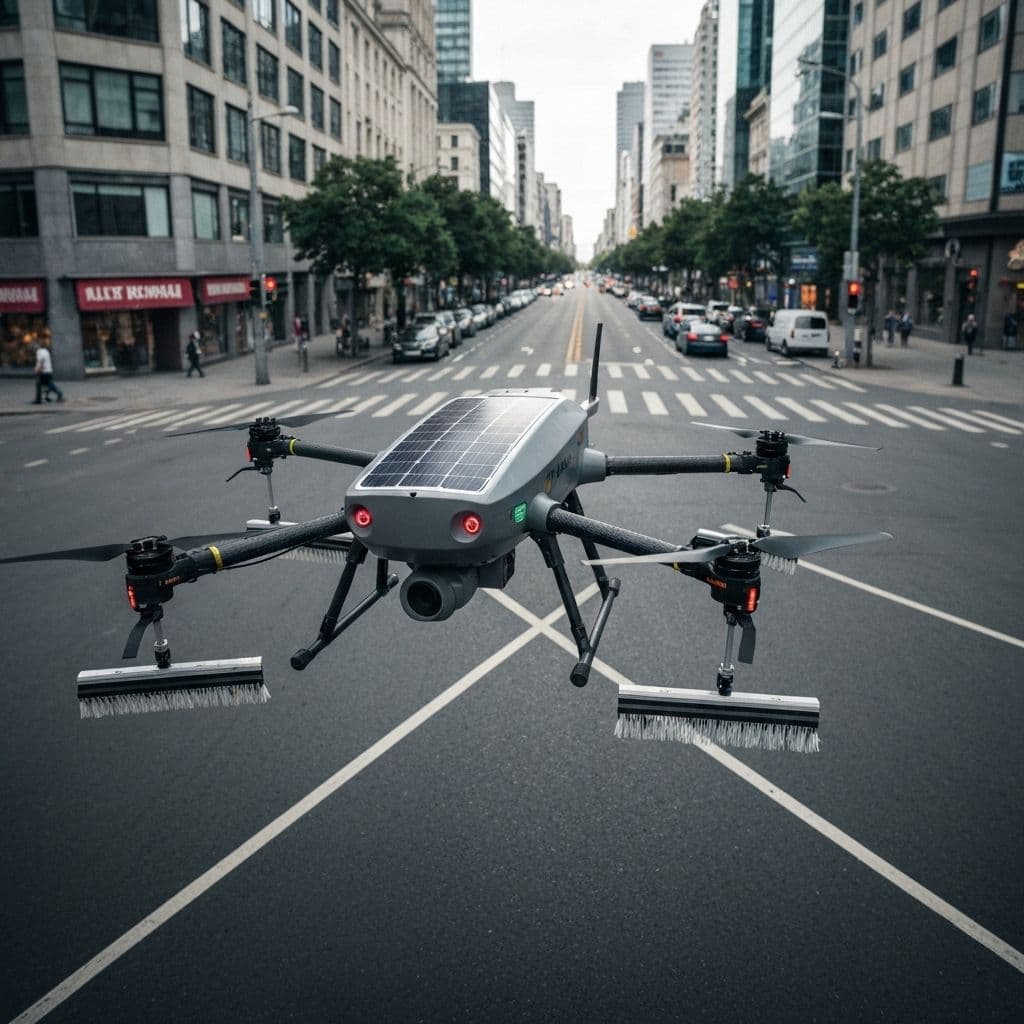
Lower occupational incident exposure
- ✅ Lower personnel risk — operators work from the ground, not exposed to work at height
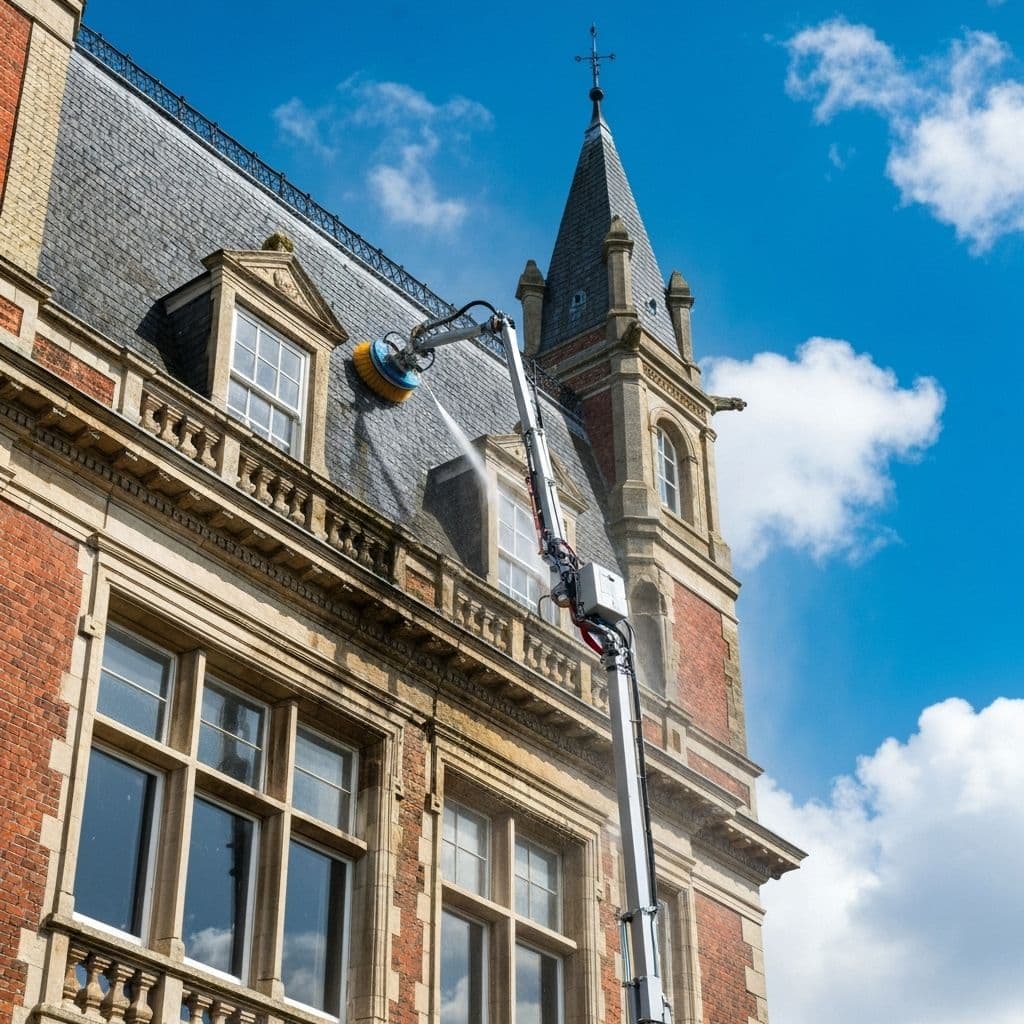
- ✅ Lower equipment risk than a boom lift or cradle
- ✅ Lower environmental impact
Lower liability exposure
- ✅ Fewer occupational incidents to begin with
- ✅ Lower damages where an incident does occur
- ✅ Lower joint liability risk for the committee
📋 6. Checklists
Selecting a contractor
- Does the contractor hold proper corporate registration?
- Does it hold the professional licences?
- Does it have the technical capability and equipment?
- Has it established and applied safe systems of work?
- Does it deliver safety training to its workforce?
- Does it have an emergency response plan?
- Does it carry employer's liability insurance? (at least NT$5 million)
- Does it carry public liability insurance? (at least NT$10 million)
- Does it carry professional indemnity insurance? (at least NT$5 million)
- Does it have experience of comparable properties?
The contract
- Is the scope of work stated clearly?
- Is safety responsibility allocated clearly?
- Is insurance responsibility allocated clearly?
- Is indemnity allocated clearly?
- Does it require the contractor to work to the safety standard?
- Does it require protective measures to be applied?
- Does it require the contractor to accept supervision?
- Does it require operational records to be provided?
- Does it specify the insurance type and sums insured?
- Does it define indemnity and its scope?
Supervision
- Was the contractor's method statement reviewed?
- Were the safety measures confirmed?
- Was the insurance confirmed as in place?
- Was the work monitored against the safety standard?
- Were the necessary safety measures required?
- Was the work recorded as evidence?
- Was the result inspected against the requirement?
- Were the contractor's operational records collected?
- Was the process reviewed and improved?
Frequently asked questions
Q1: Is a management committee always jointly liable? How is that avoided?
A: Not necessarily. Where the committee has discharged its review and supervision duties — selecting a qualified contractor, confirming the insurance position, supervising the work — it will generally not be held jointly liable. Where it has not, it may be. In one reported case a committee that had not confirmed its contractor's capability to work safely was held jointly liable for NT$8 million; in another, a committee that had discharged those duties was not. More detail: drone facade cleaning.
Q2: What insurance is needed, and at what level?
A: Three policies. Employer's liability, covering the contractor's obligation where a worker is injured — at least NT$5 million is advisable. Public liability, covering injury or property damage to third parties — at least NT$10 million. And professional indemnity, covering loss caused by professional negligence — at least NT$5 million. Ask for copies of the policies and check the type, sums insured and scope of cover.
Q3: How do we tell whether a contractor is properly qualified?
A: Three areas. Credentials: proper corporate registration, professional licences, and the technical capability and equipment for the job. Safety management: safe systems of work, a training programme, an emergency response plan and a records system. Insurance: the three policies above. Then sign a formal contract allocating responsibility and setting safety, insurance and indemnity terms, and supervise the work.
Q4: Does drone cleaning have to comply with the same regulations?
A: Yes. The risk profile is lower, but the Occupational Safety and Health Act, the facility standards and related regulation still apply — and drone operators must hold the relevant licences and comply with civil aviation regulation as well.
Q5: What should a committee do if an accident occurs?
A: Immediately:
- Stop the work and secure everyone's safety
- Notify the relevant authorities — the fire service, the labour inspection body
- Preserve the evidence — operational records, photographs, video
- Notify the insurer and open the claim
- Take legal advice on where liability sits
Q6: How is joint liability risk reduced?
A:
- Select a qualified contractor with the credentials, licences and insurance
- Sign a formal contract allocating responsibility clearly
- Supervise the work against the safety standard
- Record the work as evidence
- Consider a lower-risk method, such as drone cleaning
📌 Closing: compliance is the foundation
For a committee chair, a property manager or a plant manager, understanding the regulations, selecting a qualified contractor and planning the insurance is what protects against joint liability.
Facade work at height carries complex regulatory and insurance obligations, and when an accident occurs liability does not stop at the contractor — the committee or company that commissioned the work may be jointly liable too.
The key points
- Know the regulations — the Occupational Safety and Health Act, the Construction Safety and Health Facility Standards
- Select a qualified contractor — credentials, licences and insurance
- Sign a formal contract — with responsibility clearly allocated
- Supervise the work — against the safety standard
- Confirm the insurance — the right policies at the right level
- Record the work — as evidence
- Consider a lower-risk method — such as drone cleaning
Worth reconsidering
Knowing the regulations, selecting a qualified contractor, planning the insurance and supervising the work — those four together are what let a committee avoid joint liability while protecting residents and workers.
🚀 Arrange a regulatory consultation and risk assessment
Want to understand how compliance and risk management protect against joint liability?
What we provide
- A regulatory consultation — the regulations and duties that apply to facade work at height
- A risk assessment — the risk and liability in your current method
- Professional drone cleaning — a lower-risk method
- Complete operational records — helping you establish a proper records system
- Insurance guidance — advice on the cover to require
📞 Phone: +886-2-7733-7678 📧 Email: contact@drone168.com 🏢 Coverage: Taiwan-wide service · Taipei office only
General Drone Service Co., Ltd. — professional drone cleaning in Taiwan
Last updated: 17 January 2025
Disclaimer: this article is for general information and does not constitute legal advice. Consult a qualified lawyer on any legal question.