13 CLASSES
13 Fine-Grained Defect Classes
Hollowing, cracks, spalling, seepage, aging and more — read with a recall-first strategy: better to over-flag for professional review than to miss real risk.
So we see deterioration others can't see, and hit problems others never hit. The former is the business; the latter is the R&D — they are the same thing.
Not a generic model. inspek is trained on more than 68,000 images of real Taiwanese building facades and reads 13 fine-grained defect classes — because Taiwan's tiles, pebble-wash, and curtain walls don't look like the walls in academic datasets.
Hollowing, cracks, spalling, seepage, aging and more — read with a recall-first strategy: better to over-flag for professional review than to miss real risk.
A segmentation model and a multimodal large model cross-vote to reduce single-model misreads; every defect carries a confidence grade for professional sign-off.
Infrared thermal imagery is geometrically aligned with visible light, so ΔT anomalies map directly onto facade coordinates — hollowing isn't 'somewhere over there', it has coordinates.
Eight facade materials modeled separately — tile, stone, pebble-wash, curtain wall and more. The same shadow means hollowing on tile and may mean nothing but grime on stone.
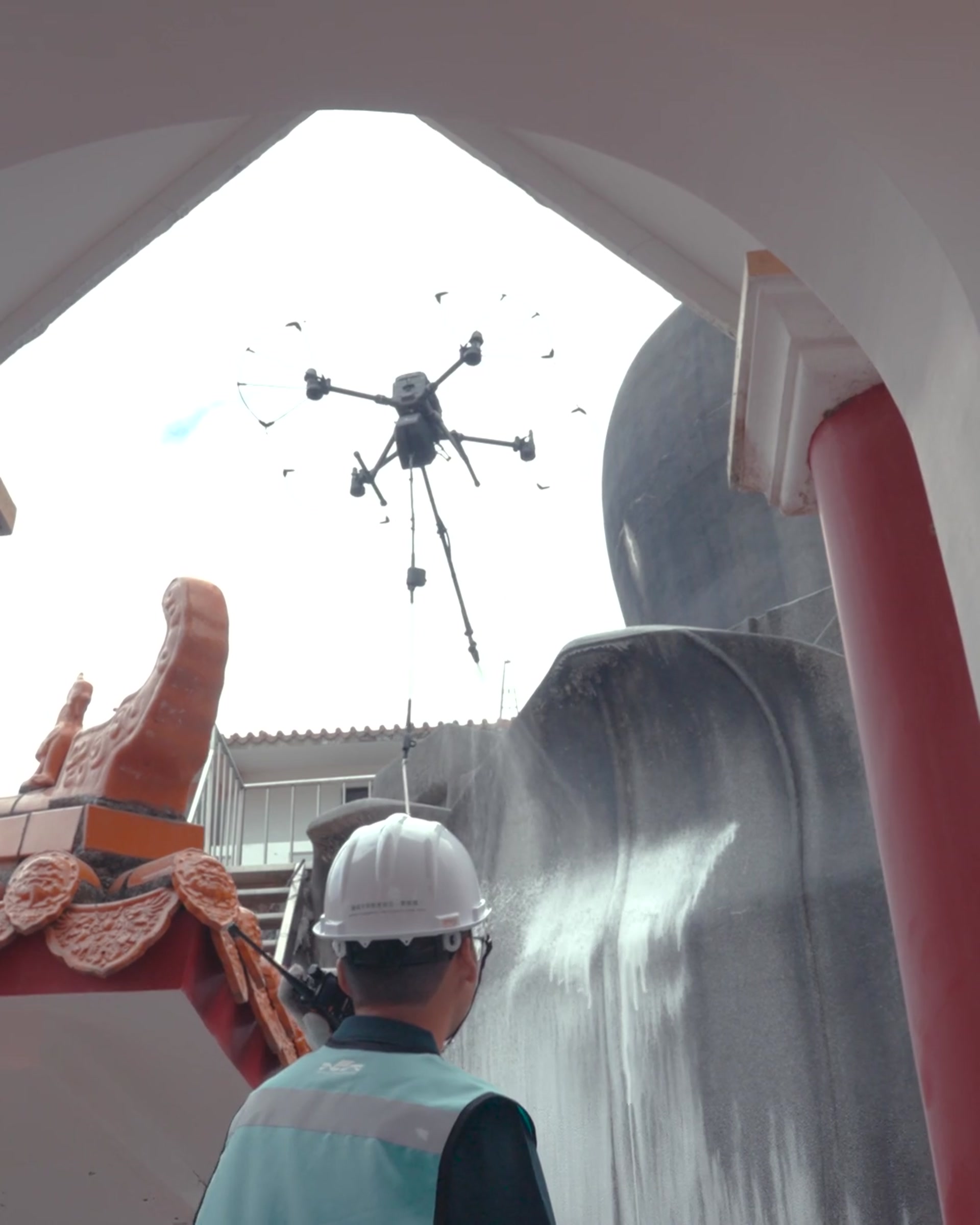
Off-the-shelf drones were never designed to fly against a glass curtain wall while fighting nozzle recoil. So we forked PX4 to build GDS-Pilot and construct our own wall-proximity aircraft.
A PX4 fork tuned for wall-proximity work: wind shear, multipath interference, and nozzle-recoil compensation — problems that don't appear in open-source default parameters.
RTK centimeter-grade positioning plus laser ranging pin every image and every defect onto the facade coordinate system, enabling precise same-path re-flights year over year.
48MP triple-lens visible camera + VOx 640×512 thermal imager (±2°C) — one flight captures both the visible and thermal data layers.
Our in-house pilot fleet works facades, solar farms, and industrial sites daily. The failure modes we design around were encountered in the field, not imagined.
Every flight feeds the model: new facades, new materials, new failure patterns. Earned with time, not bought with money.
Every building gets a 0–100 composite score across five dimensions — hollowing, cracks, spalling, seepage, aging — tracked year over year.
Every defect carries facade coordinates, a severity grade, and visible-plus-thermal evidence — auditable, reviewable, and directly actionable by contractors.
The same wall compared across years: deterioration rate, spread direction, risk curve. Problems aren't discovered; they're predicted.
Trend data projects five years of maintenance needs and budgets — turning facade upkeep from a surprise expense into a plannable item.
Want to know what condition your facade is in? Start with an asset assessment
Leave your building details and we'll arrange an on-site assessment and walk you through how the health program works