Drone cleaning versus the traditional boom lift: how to maintain a building without disturbing anyone
In brief: Drone facade cleaning works 3–5 metres off the building, with the operator on the ground rather than facing residents' windows, which removes the visual privacy exposure. Noise runs 20–30dB below a boom lift, close to ambient. On a Hsinchu premium development, moving to drone cleaning produced no privacy complaints at all and a marked rise in resident satisfaction.
In premium residential areas — Hsinchu, Taipei's Xinyi District — resident privacy and a quiet environment are what property management cares about most.
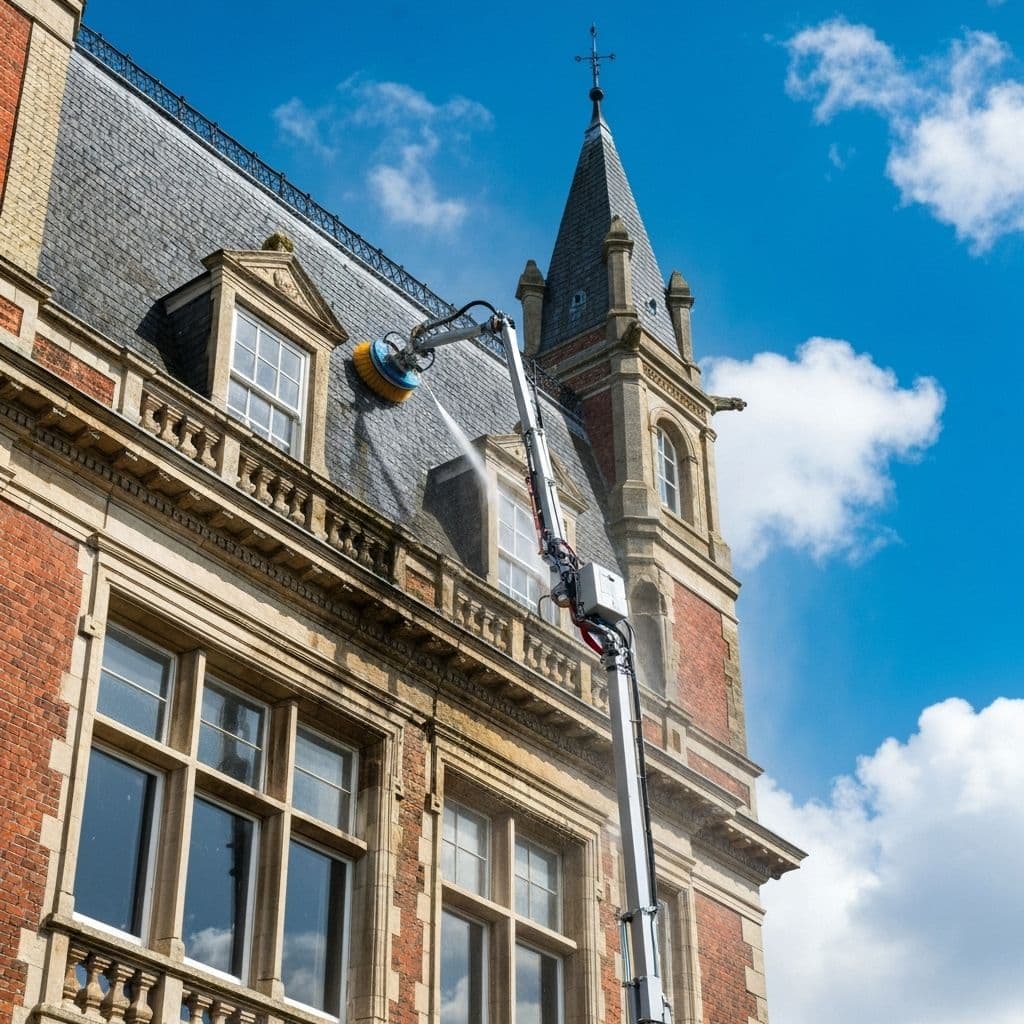
Boom lift and rope access work generates considerable noise, and it can intrude on privacy: workers may see into apartments, which is a legitimate concern. For residents of a premium building, that is simply not acceptable.
Drone facade cleaning gives premium properties a way to maintain the building without any of that.
What follows covers:
- The privacy and noise problems inherent in traditional access
- How drone cleaning protects privacy
- How drone cleaning reduces noise
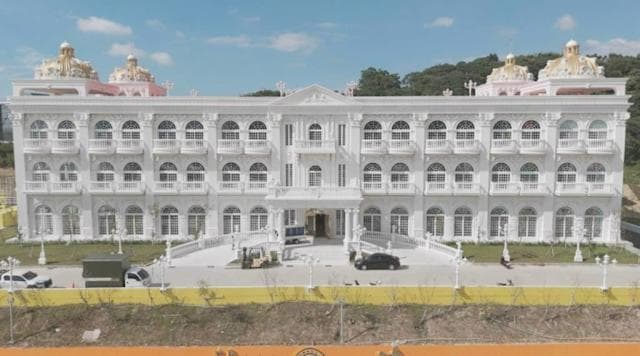
- A worked case: a premium development in Hsinchu
- How to choose a contractor for low-disruption maintenance
🔒 1. Privacy: what premium properties care about most
The privacy risks in traditional access
Visual intrusion
Working from a boom lift or on ropes, the crew:
- ❌ Faces residents' windows directly, and may see inside
- ❌ Stays in one position for extended periods, compounding the exposure
- ❌ May carry cameras that could record residents
- ❌ Cannot control line of sight in any meaningful way
What it does to residents
Even where the crew has no intention of intruding, residents may feel:
- 😰 Watched — the sense of being observed
- 😰 Unable to relax — having to keep an eye on the window
- 😰 Anxious about privacy — worrying that it has been compromised
How drone cleaning addresses it
✅ Working distance
- The aircraft works 3–5 metres off the building
- The operator controls it from the ground and is not facing residents' windows
- Onboard cameras are used for operational monitoring only, and do not record residents
✅ It keeps moving
- The aircraft moves quickly rather than lingering at a single position
- Less time affecting any one apartment
- Lower privacy exposure overall
✅ A controllable working envelope
- The route can be planned in advance to avoid sensitive areas
- The schedule can be set to avoid peak resident activity
- The working area can be bounded to what actually needs cleaning
✅ Defined privacy measures
- Residents are notified in advance, with the method and the privacy measures explained
- Camera use is strictly controlled during the work, for operational monitoring only
- No imagery involving residents' privacy is retained afterwards
🔊 2. Noise: keeping the environment quiet
The noise problem with traditional access
Equipment noise
Boom lift work generates:
- 🔊 Engine noise — running continuously
- 🔊 Compressor noise — from the cleaning equipment
- 🔊 Tool noise — from brushing and rinsing
- 🔊 Crew communication — people calling to each other
How far it carries
- Wide reach — noise carries across several floors
- Long duration — programmes run for hours, often days
- Unavoidable — residents cannot shut it out
Where drone cleaning differs
✅ A quieter operation
- ✅ Electric motors — far quieter than a combustion engine
- ✅ Working distance — the noise source sits away from the building
- ✅ Faster — a shorter programme means less time exposed to it
- ✅ Controllable — working height and distance can be adjusted to reduce it further
✅ The measured comparison
| Noise at 10 metres | Area affected | Duration | |
|---|---|---|---|
| Boom lift | 75–85 dB | Several floors | 4–8 hours |
| Drone cleaning | 55–65 dB | One floor | 2–4 hours |
| Improvement | ⬇️ 20–30 dB | ⬇️ 70% | ⬇️ 50% |
For reference: ambient noise in a residential area runs 40–50dB. Drone cleaning sits close to that.
🏠 3. A worked case: a premium development in Hsinchu
Background
Property: a premium residential development in Hsinchu Height: 25 storeys Residents: high-income professionals with high expectations of privacy and environmental quality Requirement: annual facade cleaning — but the boom lift work previously used had generated constant complaints
The problems
Privacy
- Residents reported that crews could see inside their apartments
- Concern that personal privacy was being compromised
- Pressure on management to change the method
Noise
- Boom lift noise disturbed residents' rest
- The programme ran too long, affecting quality of life
- Residents asked for it to be shortened
Efficiency
- The traditional method required areas to be closed
- Which obstructed residents' movement
- And the programme duration was hard to control
The solution
How it ran
-
Communication first
- The advantages of drone cleaning explained to residents
- The privacy measures set out
- Residents' agreement obtained
-
Planning
- Scheduled around peak resident activity
- Route planned to avoid sensitive areas
- Privacy measures defined
-
Delivery
- The facade cleaned by drone
- Camera use strictly controlled
- The operation monitored live
-
Review
- Resident feedback collected
- The process reviewed
- Improvements carried into the next programme
Results
✅ Privacy
- No privacy complaints after the change
- Resident satisfaction rose — residents were content with the measures taken
- The property's standing improved — it demonstrated that residents' privacy was taken seriously
✅ Noise
- Substantially quieter — 20–30dB lower
- A shorter programme — from six hours to three
- Resident satisfaction rose on environmental quality
✅ Efficiency
- Faster — the same building went from six hours to three
- Less area affected — no need to close off large areas
- Predictable duration — the programme could be timed accurately
✅ Cost
- Lower total cost — a slightly higher cost per operation, more than offset by reduced complaint handling and management overhead
- Long-run value — better property standing and higher resident satisfaction
📊 4. Drone versus traditional access, in full
Privacy
| Boom lift / rope access | Drone cleaning | Better | |
|---|---|---|---|
| Visual privacy | Crew faces windows directly | Working distance; not facing windows | ✅ Drone |
| Time in position | Extended periods at one point | Moves quickly, does not linger | ✅ Drone |
| Cameras | Could record residents | Operational monitoring only | ✅ Drone |
| Control | Line of sight hard to control | Route planned in advance around sensitive areas | ✅ Drone |
Noise
| Boom lift / rope access | Drone cleaning | Better | |
|---|---|---|---|
| Equipment noise | 75–85 dB | 55–65 dB | ✅ Drone |
| Area affected | Several floors | One floor | ✅ Drone |
| Duration | 4–8 hours | 2–4 hours | ✅ Drone |
| Control | Hard to control | Height and distance adjustable | ✅ Drone |
Efficiency
| Boom lift / rope access | Drone cleaning | Better | |
|---|---|---|---|
| Speed | Slower | Faster | ✅ Drone |
| Precision | Depends on the individual | Precisely controllable | ✅ Drone |
| Weather constraints | More | Fewer | ✅ Drone |
| Area affected | Large closures needed | Small footprint | ✅ Drone |
Cost
| Boom lift / rope access | Drone cleaning | Note | |
|---|---|---|---|
| Cost per operation | Lower | Slightly higher | Equipment costs more |
| Total cost | Higher | Lower | Less complaint handling and management overhead |
| Long-run value | Lower | Higher | Better property standing and resident satisfaction |
🎯 5. How to deliver maintenance residents barely notice
Preparation
Talking to residents
- ✅ Notify early — one to two weeks before the work
- ✅ Explain the method — the advantages of drone cleaning and the privacy measures in detail
- ✅ Obtain agreement — before the work begins
- ✅ Provide a point of contact — so residents can ask questions
Planning
- ✅ Choose the hours — avoiding peak resident activity, typically 8–10am and 6–8pm
- ✅ Plan the route — avoiding sensitive areas such as bedrooms and studies
- ✅ Bound the working area — cleaning only what needs it
- ✅ Prepare contingencies — for anything unexpected
Delivery
Privacy measures
- ✅ Strict camera control — operational monitoring only, no recording of residents
- ✅ Keep working distance — never directly facing windows
- ✅ Keep moving — no lingering in one position
- ✅ Monitor live — confirming the privacy requirements are being met throughout
Noise measures
- ✅ Low-noise equipment
- ✅ Adjust working height to reduce the effect
- ✅ Shorten the programme through efficient working
- ✅ Monitor noise levels live against the standard
Review
Collect feedback
- ✅ Resident satisfaction survey on the method used
- ✅ Property management feedback
- ✅ Internal team review
Improve
- ✅ Analyse what came up during the work
- ✅ Refine the process for efficiency and quality
- ✅ Update the operating standard against best practice
💡 6. Choosing a contractor
What to assess
Privacy capability
- ✅ A written privacy policy
- ✅ Defined operating procedures covering privacy
- ✅ Crew training on privacy
- ✅ Experience of premium properties
Noise capability
- ✅ Low-noise equipment
- ✅ Noise control technique
- ✅ A monitoring mechanism
- ✅ A record of continuing improvement
Professional capability
- ✅ Technical certification
- ✅ Substantial operating experience
- ✅ Professional-grade equipment
- ✅ Service standards that meet the requirement
Checklist
When commissioning low-disruption maintenance, confirm:
- Is there a written privacy policy?
- Are there defined privacy operating procedures?
- Is low-noise equipment used?
- Is there a noise monitoring mechanism?
- Is there experience of premium properties?
- Is the crew professionally trained?
- Can detailed operational records be provided?
- Can the contractor work to property management's requirements?
Frequently asked questions
Q1: Does drone cleaning genuinely protect resident privacy?
A: The aircraft works 3–5 metres off the building and the operator controls it from the ground, so nobody is facing residents' windows. We control camera use strictly — it is for operational monitoring only and does not record residents. No method is risk-free, but the privacy exposure is far lower than with traditional access. On the Hsinchu development, there were no privacy complaints at all after the change. More detail: drone facade cleaning.
Q2: Is drone cleaning actually quieter?
A: Yes. Electric motors are far quieter than a boom lift engine. Measured, drone cleaning runs 55–65dB against 75–85dB for a boom lift — 20–30dB lower and close to ambient residential noise of 40–50dB, so the effect on residents is minimal. The area affected drops from several floors to one, and time on site from 4–8 hours to 2–4.
Q3: How do you actually deliver maintenance without disturbing residents?
A: Three stages. Preparation: notify residents in advance, explain the method and the privacy measures, schedule around peak resident activity, and plan the route to avoid sensitive areas. Delivery: control camera use strictly, keep working distance, move quickly, use low-noise equipment and adjust working height. Review: collect resident feedback and improve.
Q4: Does drone cleaning suit every kind of building?
A: It suits most — tall buildings, premium residential, commercial towers. Some unusual structures or site constraints need assessing case by case, so a site survey before commissioning is worthwhile.
Q5: Is the programme shorter?
A: Yes. Drone cleaning is efficient enough to shorten the programme by 30–50%. And because the aircraft keeps moving rather than lingering, the time any individual resident is affected is shorter still.
Q6: How do we make sure a contractor can actually deliver this?
A: Choose one with proper certification, a written privacy policy and low-noise equipment. Ask for a detailed method statement and privacy measures, and write the requirements into the contract.
📌 Closing: low disruption is the standard for premium property
In premium residential and high-end commercial buildings, resident privacy and a quiet environment have become core to how property is managed.
Drone facade cleaning lets a premium property maintain its building without any of the intrusion that used to come with it. Adopting it means:
- ✅ Protecting privacy — working at distance, not facing windows
- ✅ Reducing noise — a quieter operation and a quieter environment
- ✅ Working faster — a shorter programme and less time affected
- ✅ Raising resident satisfaction — demonstrating that residents' concerns are taken seriously
- ✅ Supporting property value — building a reputation for quality
Worth reconsidering
Privacy, noise, efficiency and resident satisfaction — those four together are what make drone facade cleaning the best available option for premium property.
🚀 Arrange an assessment
Want to understand what low-disruption drone facade cleaning would mean for your building?
What we provide
- A site assessment — establishing what suits the building
- Professional drone cleaning — designed around privacy and noise
- A full method statement — the working plan and the privacy measures in detail
- Ongoing support — establishing a long-term low-disruption maintenance arrangement
📞 Phone: +886-2-7733-7678 📧 Email: contact@drone168.com 🏢 Coverage: Taiwan-wide service · Taipei office only
Get in touch to arrange an assessment.
General Drone Service Co., Ltd. — professional drone cleaning in Taiwan, delivering building maintenance residents barely notice
Last updated: 16 January 2025