Cleaning a high-rise facade without scaffolding: how drone technology makes it safe and efficient
In brief: Drone cleaning removes the need for scaffolding or a suspended cradle — the whole job is flown under remote control from ground level. Against traditional methods it removes the access cost and the erection programme entirely (see the cost comparison below), and it substantially improves the safety of the operation.
Say "high-rise facade cleaning" and most people picture the same thing: scaffolding covering an entire elevation, workers hanging in a cradle scrubbing their way across. That method is slow and labour-intensive, and it carries serious safety exposure — falls from height remain among the leading causes of death in construction.
As drone technology has matured, a different approach has started to change the industry. General Drone Service was among the first to apply drone cleaning to high-rise facades in Taiwan, delivering work that genuinely needs no scaffolding at all.
1. What is wrong with scaffolded cleaning
The cost of the scaffold itself
The largest cost in traditional facade cleaning is often not the cleaning — it is the access. On a 20-storey building:
- Scaffold erection typically accounts for 40–60% of the total, depending on area and height
- Time — 3–7 days to erect, another 2–5 days to dismantle
- Space — scaffolding occupies the pavement and surrounding ground, requiring a highway licence
- Weather — a typhoon or high winds during the programme means emergency dismantling
Safety exposure
Work at height has always been among the most dangerous work in construction:
- Falls from height are the leading cause of fatal occupational accidents
- Suspended cradles swing severely in strong wind
- Workers on scaffolding spend long periods at height, with fatigue accumulating
- Dropped tools or materials endanger pedestrians below
What it does to residents
- Scaffolding blocks daylight and disrupts daily life
- Workers operating outside windows create real privacy problems
- Construction noise runs for weeks
- Scaffolding can become a route for intruders
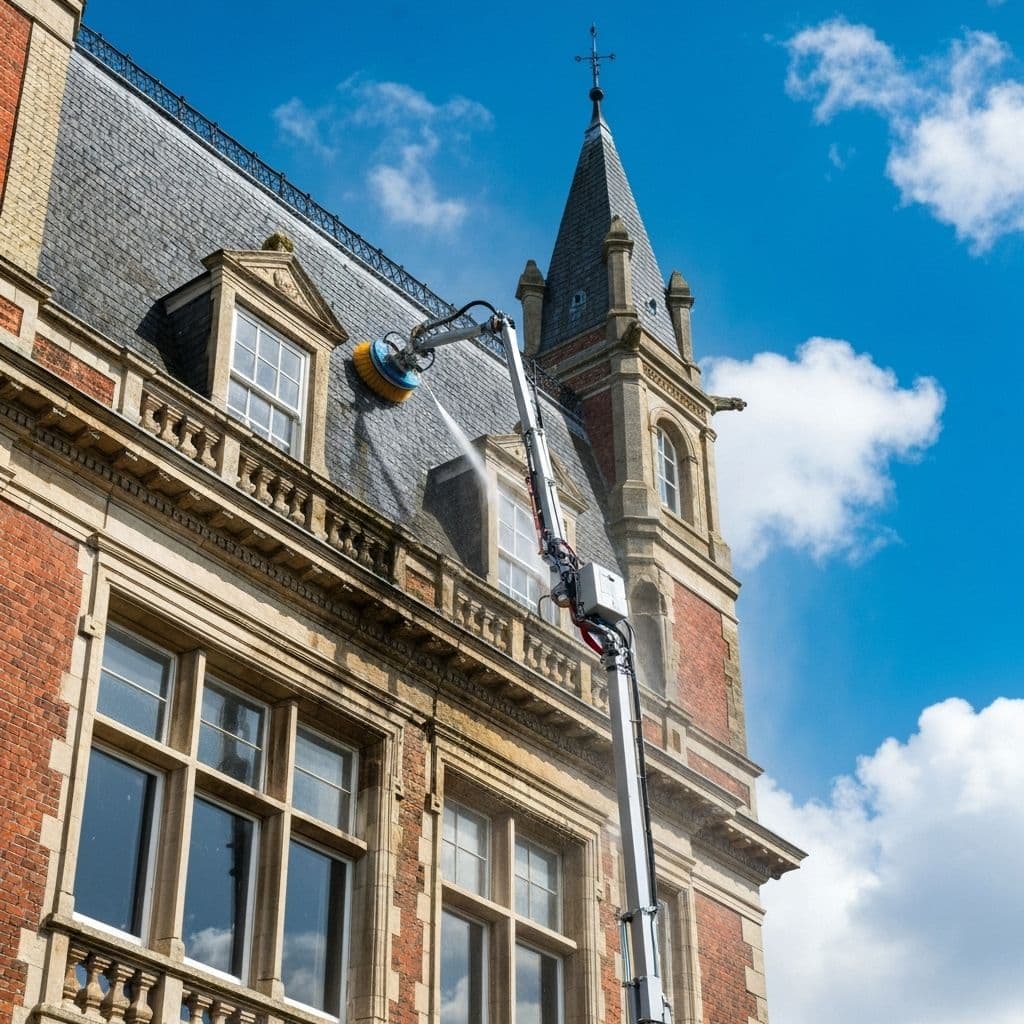
2. How drone cleaning works
The core system
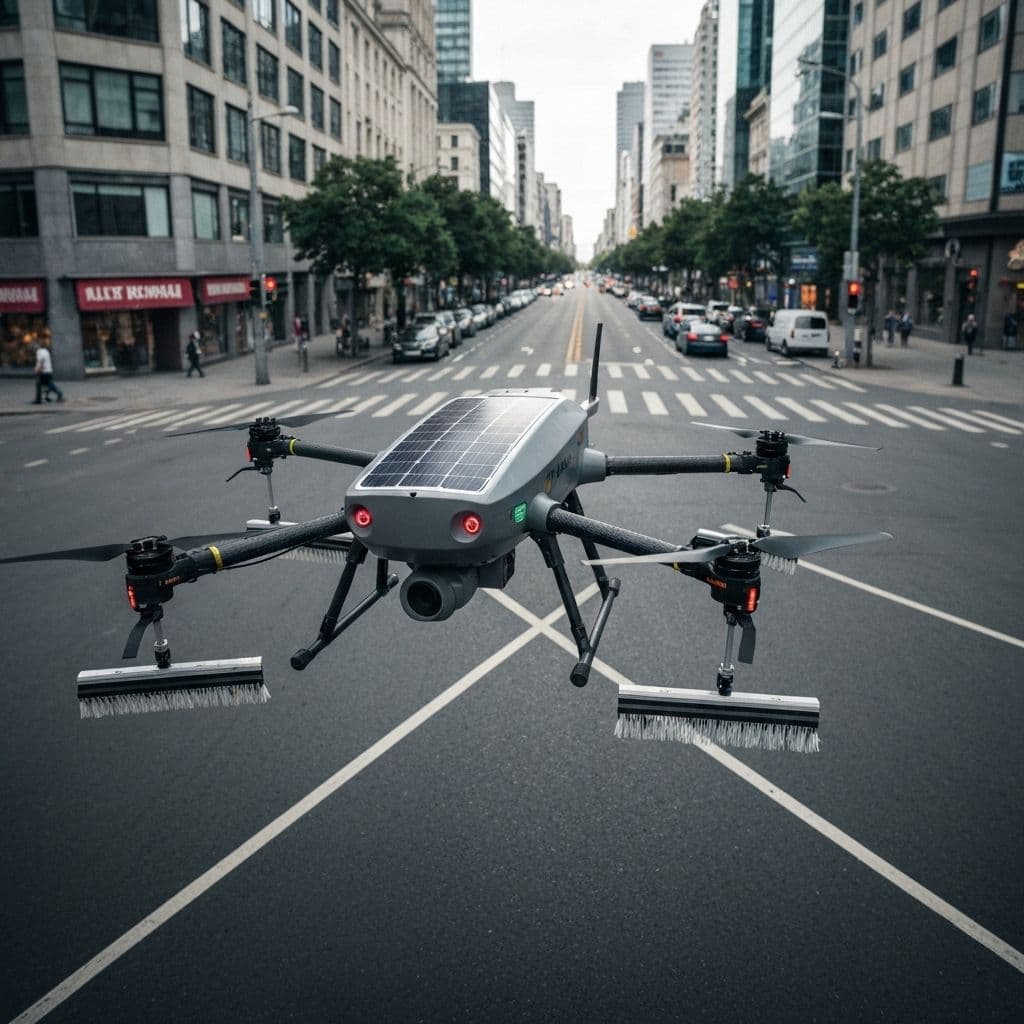
A drone facade cleaning system has three main components:
- The aircraft — a high-payload multirotor capable of stable hover and precise positioning
- The spray system — an onboard high-pressure module with controlled jet angle and pressure
- Ground supply — a ground-based pump feeding water and detergent to the aircraft through a lightweight hose
Specification
Key performance figures for our cleaning aircraft:
- Maximum working height: over 100 metres (around 30 storeys)
- Spray pressure: 100–150 bar, sufficient for most facade soiling
- Flight endurance: roughly 15–25 minutes per sortie
- Throughput: around 200–400 square metres an hour
- Positioning accuracy: GPS and visual positioning together, so coverage leaves no gaps
- Wind tolerance: normal operation up to Beaufort force 5
For the technical detail behind the method, see our diagnostic capabilities.
How a job runs
- Site survey — an aerial pass over the whole building to assess soiling and working conditions
- Planning — an optimal cleaning path worked out from the building's geometry
- Ground set-up — water supply rigged, safety exclusion zone established
- Cleaning — the operator flies the aircraft from ground level, working level by level
- Quality check — a second aerial pass confirms the standard of the clean
- Handover — before-and-after imagery and a written report
3. Safety protocol and compliance
Flight safety management
We work to the following protocol without exception:
- Pre-flight check — a full airframe inspection and system test before every operation
- Two-operator rule — one flying, one monitoring the spray system
- Live monitoring — continuous video downlink, watched by the ground team throughout
- Emergency procedure — a defined response plan including pre-planned emergency landing points
- Weather judgement — work stops once wind speed exceeds the safe threshold. There are no exceptions to this
Regulatory compliance
- Drone operating licences held per Civil Aeronautics Administration requirements
- Airspace use permits applied for as required for the working area
- Third-party liability insurance carried, protecting the surroundings
- Warning signage and a safety exclusion zone established on site
4. Cost and time compared
Cost
Taking a 15-storey commercial building with roughly 3,000 square metres of facade:
| Scaffolding | Suspended cradle | Drone cleaning | |
|---|---|---|---|
| Access / equipment | NT$150,000–250,000 | NT$50,000–100,000 | NT$0 |
| Cleaning | NT$150,000–250,000 | NT$150,000–250,000 | NT$150,000–300,000 |
| Total | NT$300,000–500,000 | NT$200,000–350,000 | NT$150,000–300,000 |
| Days on site | 15–25 | 10–15 | 3–7 |
Time
The time advantage comes from several places at once:
- No access programme — the 5–12 days of erection and dismantling disappear
- Continuous working — the aircraft cleans continuously, unconstrained by human stamina
- Fast repositioning — one elevation finished, the next begins; no scaffold to move
- Weather flexibility — work resumes quickly after a passing shower, rather than waiting for scaffolding to dry
5. Which buildings suit it
The method has a wide range, and suits some cases particularly well:
Especially well suited
- Very tall buildings (20 storeys and above) — where scaffold cost is highest and the advantage is largest
- Geometrically unusual buildings — curved or raked elevations that scaffolding cannot follow closely
- Schools and hospitals — where noise and safety requirements are strict
- Trading retail — commercial buildings that cannot close off facade areas for long
Across facade materials
- Curtain wall glazing — no scratching, with pressure precisely controlled
- Tiled facades — effective on mould and staining in the joints
- Stone facades — gentle cleaning that does not damage natural stone grain
- Metal cladding — controlled pressure avoids distortion and scratching
- Coated facades — a low-pressure mode protects the coating surface
For more on what suits your building, see facade cleaning services.
6. Environmental benefits
The method also compares well environmentally:
- 30–50% less water — precise spraying wastes far less
- Optimised detergent use — accurately proportioned, avoiding overuse
- No scaffold carbon — the transport and erection emissions disappear entirely
- Lower noise — drone operation is far quieter than scaffold erection
- Less waste — no scaffold consumables or offcuts
Closing
Scaffold-free drone facade cleaning is redefining how tall buildings are maintained. It addresses the cost and the risk of the traditional approach, and it improves efficiency, safety and environmental performance at the same time.
As one of the first companies to bring drone cleaning to Taiwan, General Drone Service continues to invest in developing and refining the method, with the aim of offering the safest and most efficient facade cleaning available. Whether your building is residential, commercial or architecturally unusual, we can put together an approach that fits it.
See facade cleaning services for the detail, or our diagnostic capabilities for the technology behind it.